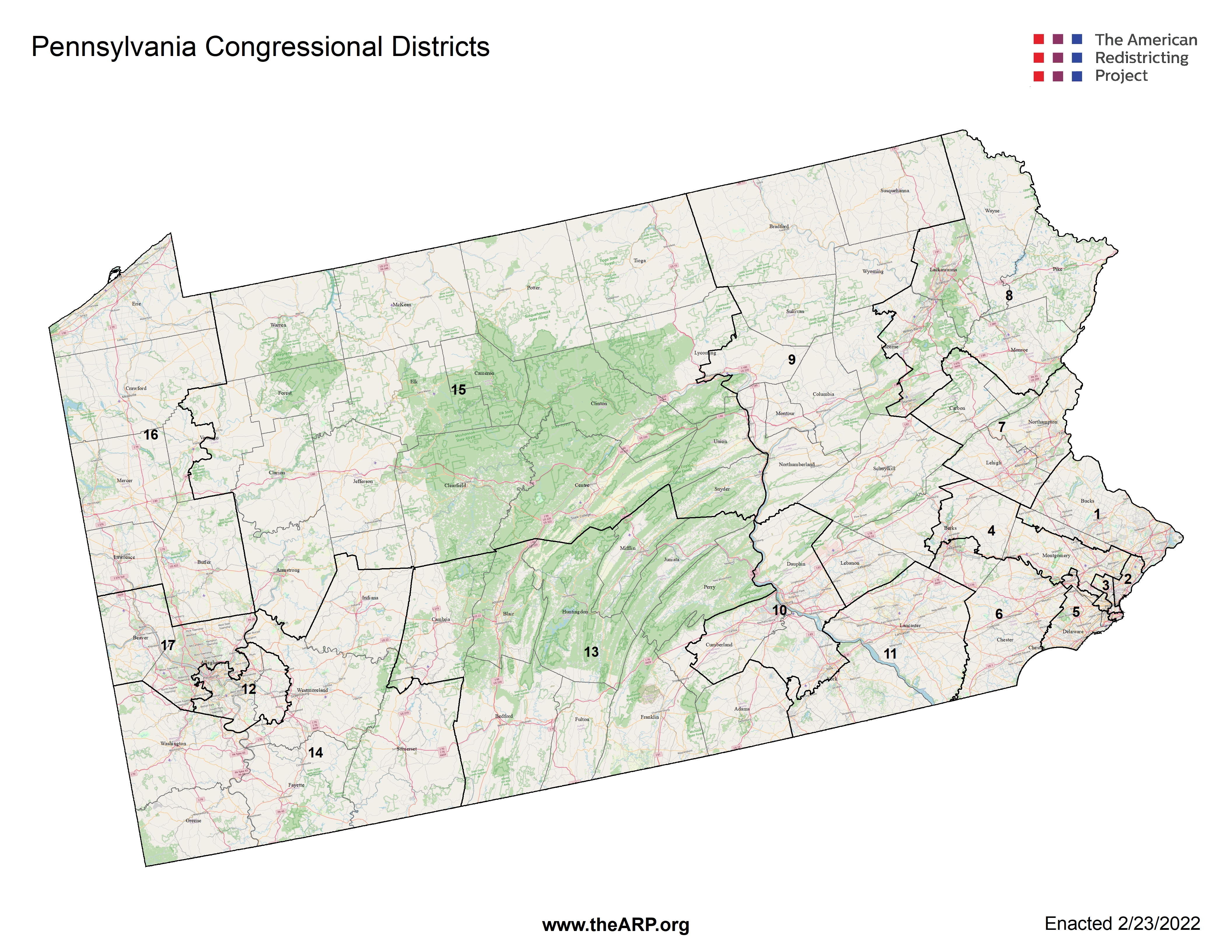
Congressional
Primary Authority: Congressional plans are enacted by the General Assembly, subject to the Governor’s veto. The General Assembly can override a veto with a 2/3 vote in each chamber. No party currently has a veto-proof majority in either chamber.
If a bill is presented to the governor during session, the governor has 10 days to sign or veto it; otherwise, it becomes law without signature. If the bill is delivered to the governor after session adjournment, the governor must sign or veto it within 30 days of session adjournment; otherwise, it becomes law. Sundays and holidays are excluded from these calculations.
Mapping Timeline: Not specified.
Redistricting Criteria: Not specified.
Map Challenges: Not specified.
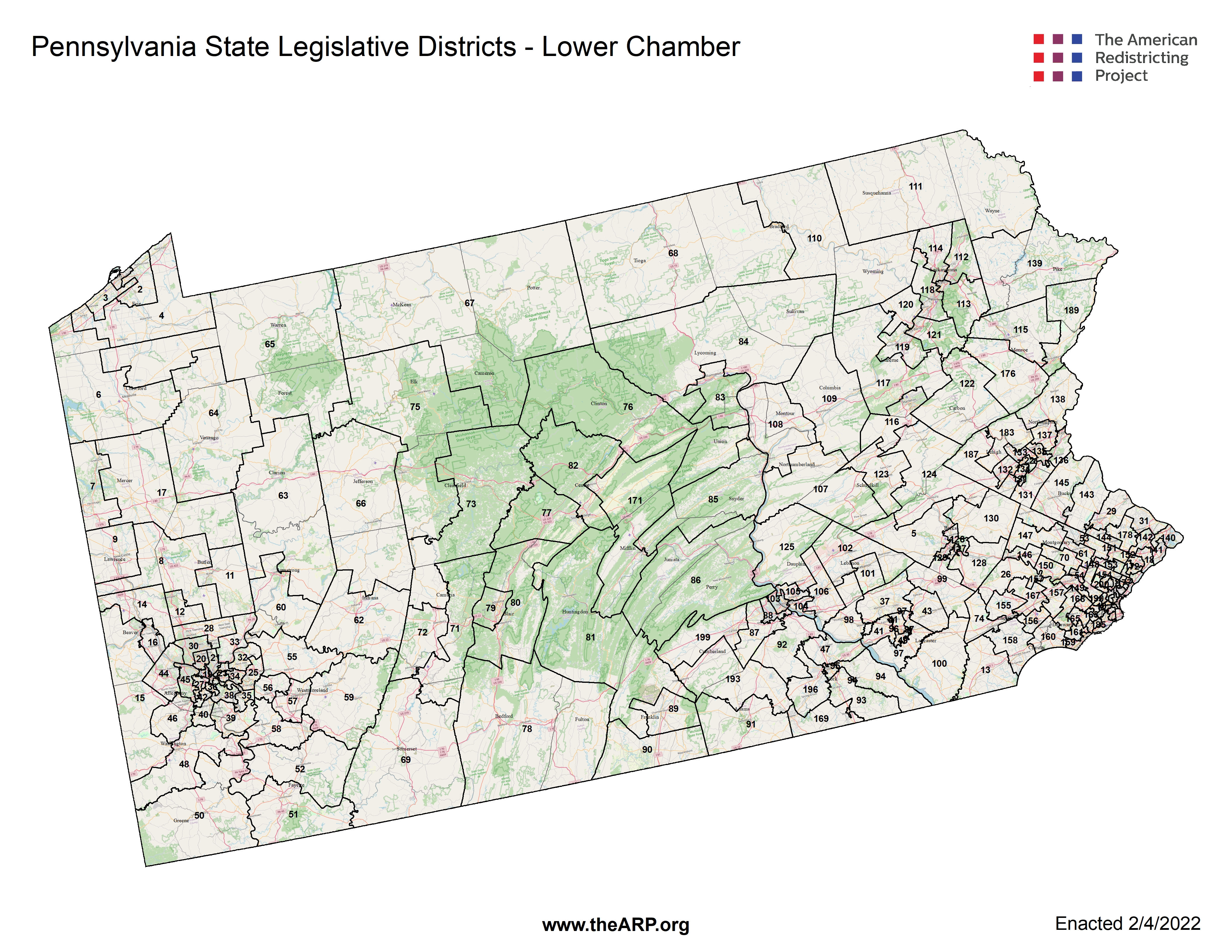
Legislative
Primary Authority: Legislative plans are adopted by the Legislative Reapportionment Commission, a 5-member politically appointed body. [Pa. Const. art. II, § 17]
- Members: The majority and minority leaders of the Pennsylvania House and Senate, or their designated deputies, each serve as members. Those initial 4 members then select a 5th member who serves as chair. If the initial 4 members fail to select a 5th, the Pennsylvania Supreme Court selects, by majority vote, the 5th member.
- Timing: The initial 4 members must be certified to the chief elections officer no later than 60 days after the reporting of the decennial census. The initial 4 must certify the 5th member to the chief elections officer within 45 days of their certification. If it falls to the Supreme Court, it must certify the 5th member within 30 days of the initial four members’ missed deadline.
- Eligibility: The 5th member who serves as chair must be a Pennsylvania citizen who is not a local, state, or federal official holding an office that receives compensation.
- Voting: Appointment of the 5th member requires a majority vote of the initial 4 members. Official Commission actions require a majority vote.
Backup Authority: If the Commission fails to file a preliminary, revised, or final plan by the relevant deadline, and the Pennsylvania Supreme Court has not extended that deadline, the Pennsylvania Supreme Court assumes legislative redistricting authority. [Pa. Const. art. II, § 17(h)]
Mapping Timeline: No later than 90 days after the Commission has been certified or the state’s decennial census data became available, whichever is later, the Commission must file a preliminary plan with the chief election officer. The Commission then has 30 days to make corrections to the plan. Within that same 30-day period, any aggrieved person can file exceptions to the plan with the Commission, in which case the Commission shall have 30 days after the date the exception(s) were filed to file a revised plan. If no exceptions are filed within the 30 days, or if they are filed and acted upon, the Commission’s plan becomes final. If a person appeals the final plan to the Pennsylvania Supreme Court, the plan does not become final until the Court has rendered its decision. [Pa. Const. art. II, § 17]
Redistricting Criteria: Compact; Contiguous; As nearly equal in population as practicable; No county, city, town, borough, township, or ward divided unless necessary. [Pa. Const. art. II, § 16]
Map Challenges: In addition to the 30-day challenge period for preliminary plans, any aggrieved person can appeal the Commission’s final plan to the Pennsylvania Supreme Court within 30 days of its filing. If the Court finds violations therein, it remands the plan back to the Commission with directions to remedy the identified deficiencies. [Pa. Const. art. II, § 17]
Ballot Measure & Referendum Processes
Types of Measures: Only the Pennsylvania General Assembly may refer amendments to the ballot. There is no initiative or referendum process. [Pa. Const. art. XI]
Previous Redistricting Cycles
2020
- Congressional
- Vetoed Plan – HB 2146
- Passed = January 24, 2022 (Split control)
- Vetoed = January 26, 2022
- Litigation History
- Carter v. Chapman, No. 7 MM 2022 (Pa. Mar. 9, 2022): On December 17, 2021, a group of Pennsylvania voters filed a lawsuit in Pennsylvania’s Commonwealth Court challenging the state's then-existing congressional districts as unconstitutionally malapportioned in violation of the one person, one vote requirement. On February 2, 2022, only a few days after the Commonwealth Court completed its trial and despite the Court having denied such requests twice already, the Pennsylvania Supreme Court granted the petitioners' third request to assume extraordinary jurisdiction over the case. On February 23, the Pennsylvania Supreme Court issued an order adopting the Carter petitioners' proposed congressional redistricting plan for use in future elections and on March 9, the Court released its full opinion detailing its reasoning.
- Toth Jr. v. Chapman, No. 1:22-cv-208 (M.D. Pa. Mar. 28, 2022): On February 11, 2022, a group of Pennsylvania voters filed a federal lawsuit challenging the Pennsylvania Supreme Court's authority to order the adoption of a congressional redistricting plan after the state legislature failed to do so, alleging violations of the U.S. Constitution’s Elections Clause and a federal statute relating to congressional reapportionment. On March 16, the district court issued an opinion and order granting the defendants' motion to dismiss the plaintiffs' Elections Clause claims on the grounds they had failed to establish an injury-in-fact necessary for Article III standing. The plaintiffs filed a petition for a writ of certiorari with the U.S. Supreme Court on February 28, which the Court denied on March 7. The plaintiffs voluntarily dismissed the case on March 28, 2022.
- Legislative
- Commission’s Original Plans
- Adopted = February 4, 2022
- Litigation History
- Covert v. 2021 Pennsylvania Legislative Reapportionment Comm'n, No. 4 WM 2022 (Pa. Mar. 16, 2022): On February 15, 2022, a group of Pennsylvania voters filed a petition with the Pennsylvania Supreme Court challenging the Pennsylvania Legislative Reapportionment Commission's adopted legislative plan as violating various state constitutional redistricting criteria including compactness, contiguity, and minimizing political subdivision splits. On March 16, 2022, the Pennsylvania Supreme Court issued an order upholding the adopted legislative plan as constitutional and dismissing all of the petitions brought against it.
- Benninghoff v. 2021 Legislative Reapportionment Comm'n, No. 11 MM 2022 (Pa. Mar. 16, 2022): On February 17, 2022, the Majority Leader of the Pennsylvania House of Representatives filed a petition with the Pennsylvania Supreme Court challenging the 2021 Legislative Reapportionment Commission's adopted state House and state Senate redistricting plans as violating several different provisions of the U.S. and Pennsylvania Constitution. Plaintiff’s claims included partisan gerrymandering in violation of the Pennsylvania’s Constitution’s Free and Equal Elections Clause; racial gerrymandering in violation of the 14th and 15th Amendments and the Voting Rights Act; excessive population deviations in violation of one person, one vote; violations of the state’s respect for political subdivisions redistricting criterion; and that the commission lacked authority to reallocate incarcerated persons to their prior home addresses for redistricting purposes. On March 16, 2022, the Pennsylvania Supreme Court issued an order upholding the adopted legislative plan as constitutional and dismissing all of the petitions brought against it.
- Boscola v. 2021 Legislative Reapportionment Comm'n, No. 14 MM 2022 (Pa. Mar. 16, 2022): On March 1, 2022, a sitting Pennsylvania state Senator filed a petition with the Pennsylvania Supreme Court challenging the Pennsylvania Legislative Reapportionment Commission's adopted legislative plan as violating the state constitution’s respect for political subdivisions redistricting criterion. On March 16, 2022, the Pennsylvania Supreme Court issued an order upholding the adopted legislative plan as constitutional and dismissing all of the petitions brought against it.
- Roe v. 2021 Legislative Reapportionment Comm'n, No. 16 MM 2022 (Pa. Mar. 16, 2022): On March 7, 2022, a Pennsylvania voter filed a petition with the Pennsylvania Supreme Court challenging the Pennsylvania Legislative Reapportionment Commission's adopted legislative plan as violating various provisions of the state constitution. Plaintiffs’ claims included excessive population deviations and pairings of Republican incumbents as a result of partisan gerrymandering in violation of the Pennsylvania Constitution’s Free and Equal Elections Clause; racial gerrymandering in violation of the Free and Equal Elections, Racial Ethnic Equality, and Equal Protection Clauses; unnecessary political subdivision splits; and that the commission lacked authority to reallocate incarcerated persons to their prior home addresses for redistricting purposes. On March 16, 2022, the Pennsylvania Supreme Court issued an order upholding the adopted legislative plan as constitutional and dismissing all of the petitions brought against it.
2010
- Congressional
- Original Plan – SB 1249
- Passed = December 20, 2011 (R-controlled)
- Signed = December 22, 2011
- Litigation History
- Agre v. Wolf, 284 F.Supp.3d 591 (E.D. Pa. 2018): Plaintiffs challenged the General Assembly’s enacted congressional plan as an unconstitutional partisan gerrymander in violation of the U.S. Constitution’s Elections Clause. On January 10, 2018, the federal district court upheld the plan, finding that the plaintiffs’ Elections Clause-based partisan gerrymandering claim was a non-justiciable political question.
- League of Women Voters of Pa. v. Commonwealth, 178 A.3d 787 (Pa. 2018): Plaintiffs challenged the General Assembly’s enacted congressional plan as an unconstitutional partisan gerrymander in violation of the Pennsylvania Constitution’s Free and Equal Elections Clause. On January 22, 2018 the state Supreme Court ruled that the congressional plan violated the state constitution’s Free and Equal Elections Clause and on February 7, 2018, issued an opinion outlining its rationale and ordering the General Assembly to enact a remedial plan by February 15, 2018.
- League of Women Voters of Pa. v. Commonwealth, 181 A.3d 1083 (Pa. 2018): After the Republican-controlled General Assembly failed to pass a remedial congressional plan, the Pennsylvania Supreme Court ordered the adoption of its own congressional plan on February 19, 2018, for use in the 2018 and future elections.
- Legislative
- Commission’s Plan
- Adopted = December 12, 2011
- Struck Down = January 25, 2012 (by Pennsylvania Supreme Court)
- Litigation History
- Holt v. 2011 Legislative Reapportionment Comm’n, 38 A.3d 711 (Pa. 2012): Several different groups of plaintiffs filed challenges to the constitutionality of the Legislative Apportionment Commission’s 2011 legislative plans on various grounds, including excessive splitting of municipal subdivisions and vote dilution in violation of the Voting Rights Act. On January 25, 2012, the state Supreme Court ruled that the 2011 legislative plan violated the state constitution and remanded the plan back to the commission to be redrawn, but allowed the 2012 elections to proceed using the prior decade’s districts.
- Pileggi v. Aichele, 843 F.Supp.2d 584 (E.D. Pa. 2012): After the Pennsylvania Supreme Court invalidated the 2011 legislative plan and ordered the 2001 plan be used for the 2012 elections, plaintiffs filed a federal lawsuit seeking to enjoin the use of the 2001 plan on the grounds that population shifts had caused the 2001 districts to be malapportioned in violation of the one person, one vote constitutional principle. On February 8, 2012, the district court ruled in favor of the defendants, finding that the special circumstances of the case required the 2012 elections to proceed under the only valid plan then in existence.
- Holt v. 2011 Legislative Reapportionment Comm’n, 67 A.3d 1211 (Pa. 2013): After the Legislative Reapportionment Commission adopted its remedial legislative plans on June 8, 2012, plaintiffs again challenged it as violating the state constitution on the grounds it unnecessarily divided political subdivisions, was not sufficiently compact, was drawn to secure partisan advantage, and violated minority voting rights protected by the Voting Rights Act and Due Process Clause. On May 8, 2013, the Pennsylvania Supreme Court ruled in favor of the defendants on all claims and upheld the plans as valid.
2000
- Congressional
- Original Plan – SB 1200
- Passed = January 3, 2002 (R-controlled)
- Signed = January 7, 2002
- Litigation History
- Erfer v. Commonwealth, 794 A.2d 325 (Pa. 2002): Plaintiffs challenged the General Assembly’s enacted congressional plan as an unconstitutional partisan gerrymander in violation of the state constitution’s Equal Protection guarantee and Free and Equal Elections Clause. On March 15, 2002, the Pennsylvania Supreme Court upheld the plan, finding that the plaintiffs had failed to establish that it was a partisan gerrymander in violation of the Pennsylvania Constitution.
- Vieth v. Pennsylvania, 195 F.Supp.2d 672 (M.D. Pa. 2002): Plaintiffs filed a federal lawsuit challenging the General Assembly’s enacted congressional plan as violating the constitutional one person, one vote principle. On April 8, 2002, the district court struck down the plan as malapportioned in violation of the one person, one vote constitutional requirement and ordered the General Assembly to enact a new, properly apportioned plan.
- Remedial Plan – HB 2454
- Passed = April 17, 2002 (R-controlled)
- Signed = April 18, 2002
- Vieth v. Pennsylvania, 241 F.Supp.2d 478 (M.D. Pa. 2003): After the General Assembly enacted its remedial congressional plan, plaintiffs filed a federal lawsuit challenging the remedial plan as unconstitutional based on alleged violations of the one person, one vote constitutional requirement and of partisan gerrymandering. On January 24, 2003, the district court ruled in favor of the defendants and upheld the remedial plans as constitutional.
- Legislative
- Commission’s Plan
- Passed = November 19, 2001
- Finalized = December 28, 2001 (minor adjustments)
- Litigation History
- Albert v. 2001 Legislative Reapportionment Comm’n, 790 A.2d 989 (Pa. 2002): Plaintiffs challenged the Legislative Apportionment Commission’s enacted legislative plans as violating the state constitution on the grounds it excessively divided political subdivisions when not necessary and failed to comply with the one person, one vote constitutional principle. On February 15, 2002, the Pennsylvania Supreme Court approved the commission’s final plan as constitutional.
In The News
- Justices won’t Wade into Pennsylvania Redistricting Spat, Courthouse News Service (10/31/22)
- The Leader of the Pa. House Republicans is Appealing the State Legislative Maps to the U.S. Supreme Court, The Philadelphia Inquirer (7/14/22)
- Pa. Supreme Court Rejects Legal Challenges to State’s New Legislative Maps, Spotlight PA (3/16/22)
- Supreme Court Asked to Intervene in Congressional Maps Case, AP (2/28/22)
- Pennsylvania High Court Picks New Map of US House Districts, AP (2/23/22)
- Judge Recommends Congressional Map Favored by GOP Lawmakers, AP (2/7/22)
- Final Pa. Legislative Maps Approved by Redistricting Panel, but Legal Challenges Likely, Spotlight PA (2/4/22)
- The Pa. Supreme Court Just Took Over a Redistricting Case and will Decide the State’s New Congressional Map, The Philadelphia Inquirer (2/2/22)
- Pennsylvania High Court May Step in to House Districts Case, AP (1/31/22)
- Pennsylvania Governor Vetoes GOP-Approved Congressional Map, The Hill (1/27/22)
- General Assembly Sends Pennsylvania Congressional Map to Wolf, The Center Square (1/25/22)
- Which Map Would you Choose for Pennsylvania's Congressional Districts? NBC Philadelphia (1/25/22)
- Court Sets Deadline to Break Stalemate on Congressional Map, AP (1/18/22)
- Gov. Wolf Unveils Proposed Congressional Maps, 69 News (1/16/22)
- House Votes for GOP-Favored Congressional Redistricting Plan, AP (1/12/22)
- Pa. Lawmakers Nearing Deadline for New Congressional Map, WHYY (1/11/22)
- PA Lawsuit Asks State Supreme Court to Intervene in Redistricting, Public News Service (1/7/22)
- Bid to Help Latinos Win More Seats Misses Mark, Critics Say, AP (12/28/21)
- Pennsylvania Congressional Redistricting Fight Heats Up as Gov. Wolf Pushes Back on House GOP Proposal, The Philadelphia Inquirer (12/28/21)
- Warnings Issued Over Redistricting Delays Affecting Primary, AP (12/22/21)
- Panel Gives State House, Senate District Maps Preliminary OK, AP (12/16/21)
- House GOP Advances Amended Pennsylvania Congressional Map Before Public can Analyze it, Spotlight PA (12/15/21)
- Congressional Redistricting Process Inches Forward in Pa. House, Penn Live (12/13/21)
- Pa. House Republicans Just Proposed the First Congressional Map in a High-Stakes Redistricting Process, The Philadelphia Inquirer (12/8/21)
- Gov. Wolf Announces New Principles from Pa. Redistricting Advisory Council, Your Erie (11/24/21)
- Wolf Creates New Redistricting Oversight Panel Ahead of Fraught Map-Drawing Process, WHYY (9/13/21)
- Pennsylvania Southwestern 14th Congressional District Asks to Stay Whole, The Center Square (8/26/21)
- In Major Shift, Pa. Panel Votes to Count Incarcerated People in Home Districts, not State Prisons, Spotlight PA (8/24/21)
- Advocates Say Pa. Redistricting Process must Prioritize Public Input, Communities’ Intactness, Pittsburgh Post-Gazette (8/4/21)
- Online Tool Allows Pa. Residents to Submit Redistricting Ideas, WTAJ (8/3/21)
- Pennsylvania Republicans Promise Transparency During Redistricting. Why that won’t Help a Bit, The Morning Call (7/15/21)
- Panel Agrees to Put Guardrails on how Pa. Lawmakers Draw Congressional Maps, but not their Own, Spotlight PA (6/22/21)
- Census Data Reveals Shift in Population from Small Communities to Suburbs and Cities, The Daily Item (6/4/21)
- Pa. Supreme Court Picks Former Pitt Chancellor to Chair Powerful Redistricting Commission, Spotlight PA (5/3/21)
- PA Supreme Court to Decide Redistricting Commission Chair, Local 21 News (5/1/21)
- Pennsylvania Population Lag Costs State a US House Seat, AP (4/26/21)
- Pennsylvania Expected to Lose Congressional District, WGAL (4/15/21)
- Lawmakers Look to Limit Redistricting Chair’s Political Ties, AP (3/23/21)
- Pennsylvania's 2022 Primary Election could be Postponed due to Census Delay, The Daily Pennsylvanian (3/4/21)
- Constitutional Amendment on Districts for PA. Court Elections Shelved... for now, The Times (2/17/21)
- Redistricting Rulings were Pivotal to Democrats' Control of Congress, The Supreme Courts (1/11/21)
- Pennsylvania's Population Stagnates as Reapportionment Nears, The Center Square (12/23/20)
- Pennsylvania Republicans Held on to the State Legislature. But Democrats Still Feel Good about Redistricting. Here's Why, The Philadelphia Inquirer (11/23/20)
- Redistricting Reform Bill Moved to Senate Floor, My Ches Co (9/25/20)
- Lawmakers' Power to Redraw PA.'s Political Maps Could be more Limited, The Philadelphia Inquirer (9/22/20)
- Fewer Pennsylvanians are Participating in the Census than a Decade Ago, WSKG (9/3/20)
- Census Countdown is on, But a Lot of Pennsylvanians Haven't Been Counted, Penn Live (8/1/20)
- Senate Approves Measure for Constitutional Amendment to Create Judicial Districts, Lancaster Online (7/16/20)
- Lawmakers Will Rule Again Over Redrawing of PA. Political Boundaries, but Critics Aren't Giving Up, Spotlight PA (7/8/20)
- Harrisburg Lawmakers to Blame for Failure to End Gerrymandering of State Legislative Maps, Group Leader Says, The Morning Call (6/26/20)
- Pa. approaching a legislative crossroad, Penn Live/The Patriot-News (5/23/20)
- Lawmakers try to alter voter-approved redistricting reforms, AP (3/5/20)
- More states to use redistricting reforms after 2020 census, AP (3/5/20)
- Americans continue to vote with their feet towards low-tax states, The Hill (3/3/20)
- State sued over counting inmates in legislative districts, AP (2/27/20)
- Pennsylvania state senators lead bipartisan effort to reform state's redistricting, The Center Square (2/24/20)
- ‘It’s not red. It’s not blue. It’s just fair.’ Redistricting reform back in spotlight in Pa., Centre Daily (1/30/20)