
Total Citizen and Non-Citizen Population
The ACS 5-year Estimates from 2020-2024 peg the total resident population of the United States at 334,922,499 including 312,247,827 citizens (93.2% of the total population) and 22,674,672 non-citizens (6.8%).
Methodology
Fair Lines America Foundation used the ACS 5-year Estimates from 2020-2024 to forecast how the Census Bureau would reapportion congressional representation based on the total citizen population rather than the total resident population. A weighted growth rate was used to calculate the 2030 citizen population estimates.
These forecasts are based upon the citizen and non-citizen population estimates produced from the American Community Survey and released by the Census Bureau.
Apportionment Based on Citizenship
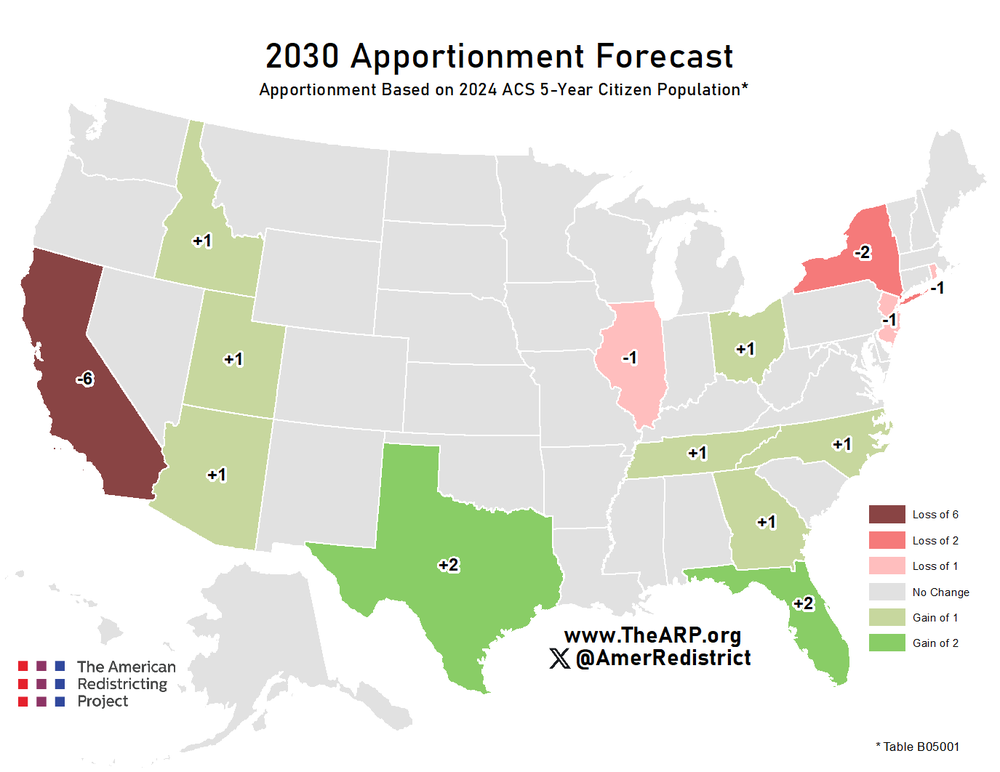
If the United States apportioned representation based on the total citizen population, California would lose six seats in the U.S. House of Representatives; New York would lose two; Illinois, New York, and Rhode Island would each lose one. Texas and Florida would gain two congressional seats each. Arizona, Georgia, Idaho, North Carolina, Ohio, Tennessee, and Utah would also each gain a seat.