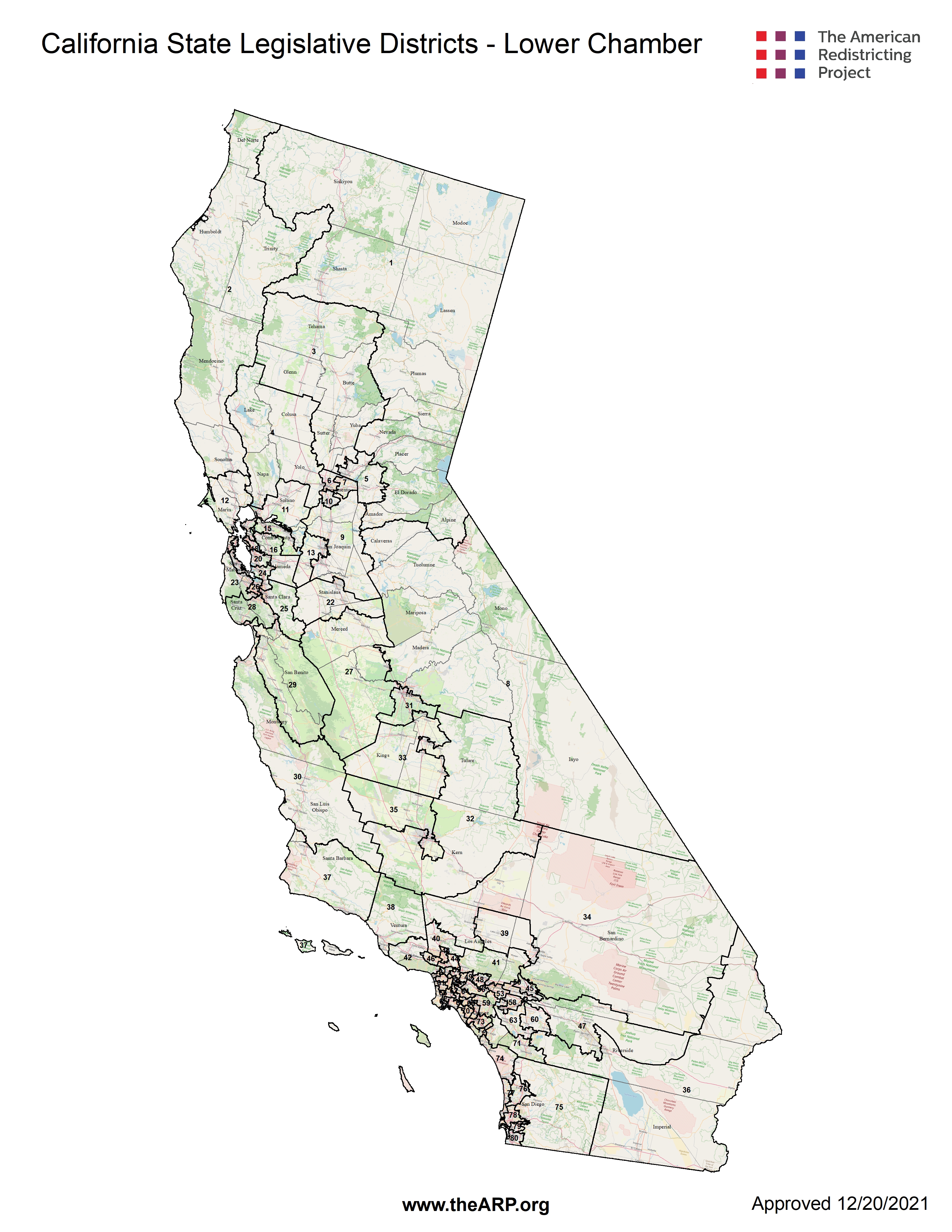
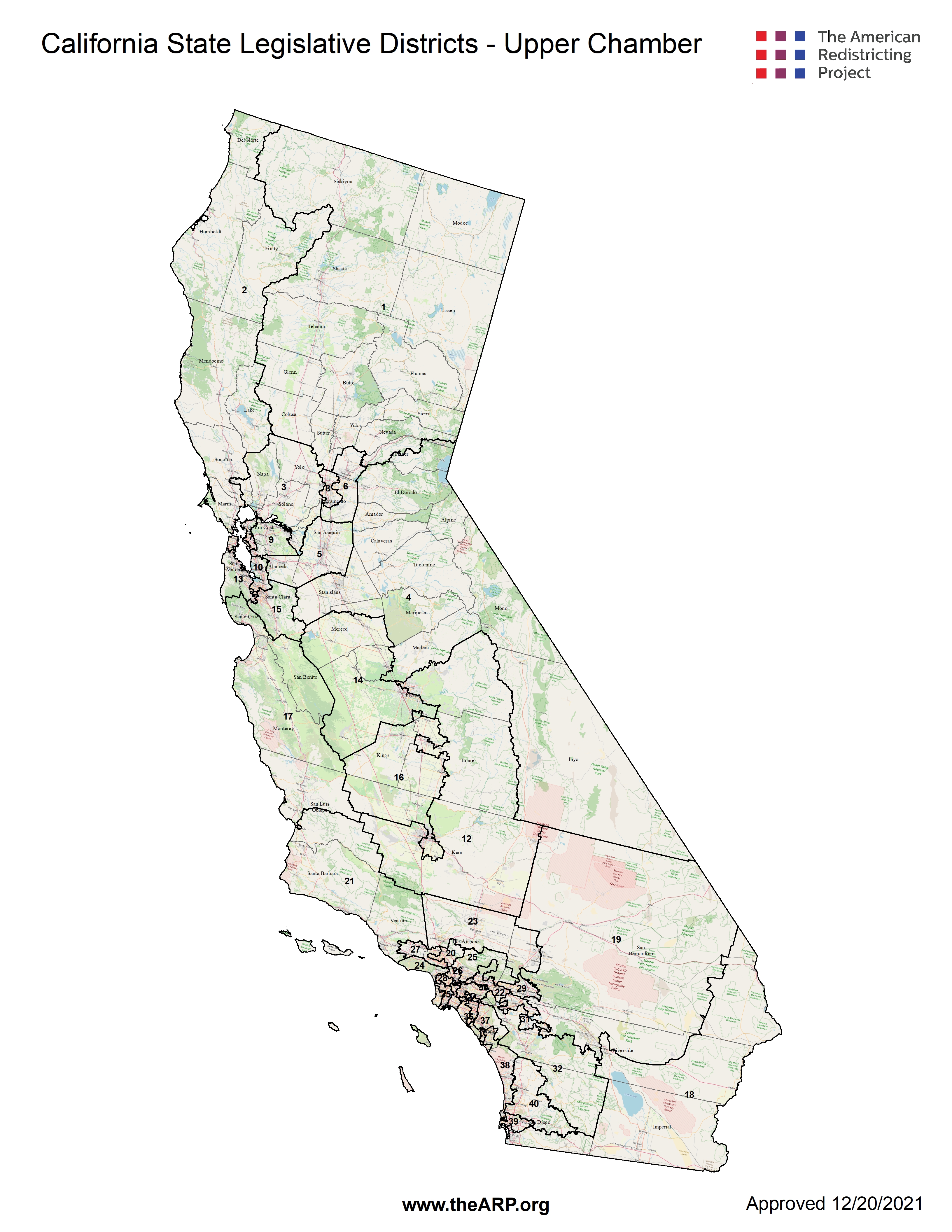
Congressional and legislative plans are drawn and adopted by the California Citizens Redistricting Commission, a 14-member body of randomly selected citizen-applicants.
California’s congressional delegation shrunk from 53 seats to 52 (a loss of 1 seat) following the 2020 reapportionment.
Primary Authority: Congressional and legislative plans are drawn and adopted by the California Citizens Redistricting Commission, a 14-member body of randomly selected citizen-applicants. 5 Commissioners are registered with the state's largest political party, 5 with with second largest party, and 4 who aren't affiliated with either of those parties. Final plans are subject to referendum.
Backup Process: If the Commission fails to approve a final map by the requisite number of voters, or if voters reject a map by referendum, the Secretary of State immediately petitions the California Supreme Court for an order appointing special masters to fashion a plan in accordance with the state’s redistricting criteria and requirements. The Court approves the special masters’ plan and certifies it to the Secretary of State, at which point it becomes effective. [Cal. Const. art. XXI, §§ 2, 3]
Mapping Timeline: The Commission must adopt and release preliminary congressional, legislative, and State Board of Equalization plans, one each, no later than July 1 in years ending in 1 for a public comment period of at least 14 days. Subsequently released preliminary plans must have a public comment period of at least 7 days. By August 15 in years ending in 1, the Commission must adopt final congressional, legislative, and Board of Equalization plans and certify them to the Secretary of State along with an explanatory report, at which point the maps are considered enacted. [Cal. Const. art. XXI, § 2; Cal. Gov. Code § 8253]
Redistricting Criteria:
Map Challenges: Filed in the California Supreme Court. Commission has sole legal standing to defend any action against a certified final map and decides whether Attorney General or other counsel shall assist in its defense. Any registered California voter may file a petition within 45 days after the Commission has certified a final map to the Secretary of State to bar the implementation of a plan on the grounds it violates the U.S. or California Constitution or federal or state law. May also file a petition to seek relief where a certified final map is subject to a referendum measure that is likely to qualify and stay the timely implementation of the map. If the Court determines the map violates any of those provisions, the Court shall fashion the relief that it deems appropriate, including the appointment of special masters to adjust the map’s boundaries. Upon approving an adjusted map, the Court certifies it to the Secretary of State at which point it becomes effective. [Cal. Const. art. XXI, §§ 2, 3]
Types of Measures: Direct initiatives and referendums are permitted to amend statutes. Direct initiatives are permitted to amend the state constitution. Legislatively initiated ballot measures may amend both statutes and the state constitution.
Single-Subject Rule: Yes.
Initiative Subject Restrictions: Initiative measures cannot contain a provision guaranteeing its approval should it only get a certain percentage of votes.
Signature Requirements: Constitutional amendments require signatures equal to 8% of all votes cast for all candidates for governor in the last general election, 5% for all other initiatives, and 5% for a veto referendum. 10,933,009 people voted for a gubernatorial candidate in the 2022 general election in California, so 874,641 signatures are required for constitutional amendments; 546,651 signatures are required for any other initiative; and 546,651 signatures are required for a veto referendum.
Submission Deadlines: Initiative petitions must be submitted 131 days before the next general election (June 27, 2024). Referendums must be submitted within 90 days from the date the legislative bill was chaptered by the Secretary of State.
Circulation Period: The circulation period for initiative petitions is 180 days.
Ballot Title and Summary: The ballot title and summary are written by the Attorney General. Expedited reviews for titles and summaries are permitted.
Other Requirements: A fiscal impact statement is required. Circulators are required to be 18 years old and a resident of California. There are no supermajority requirements. The legislature can amend or repeal an approved initiative statute by referring another statute to the people. Referendums may not provide for tax levies or appropriations for current expenses of the state. Initiatives are permitted on general, primary, and special election ballots, but not on odd-year ballots.
[Cal. Const. art. II; Cal. Elec. Code §§ 100 — 108, 9000 — 9610; California Elections Division Website]
2020
2010
2000
Current districts for California by chamber, shaded by the incumbent’s party.
To view past district shapefiles, see our Map Archive Page.
All commissioner biographies can be found here.
Consolidated with Noyes v. Newsom.