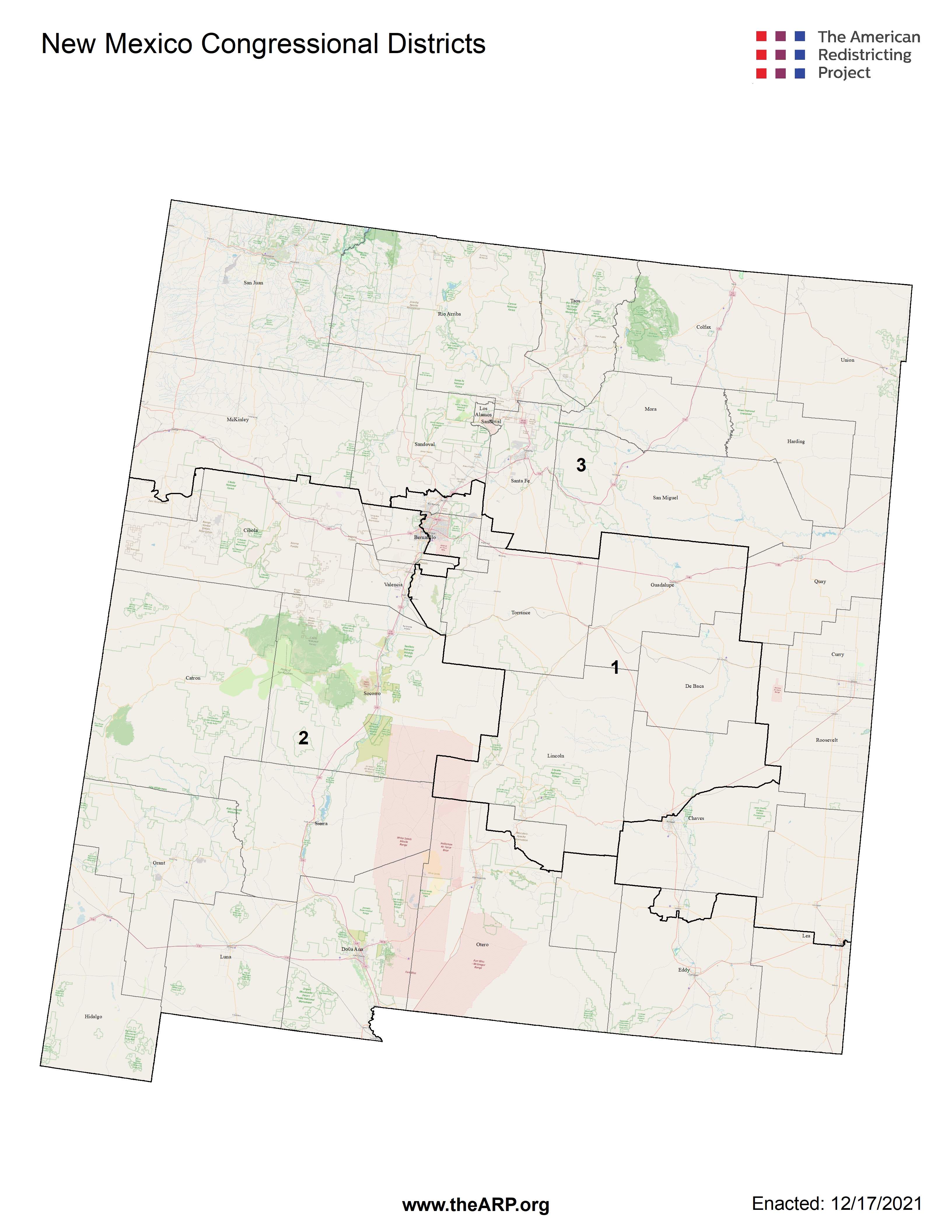
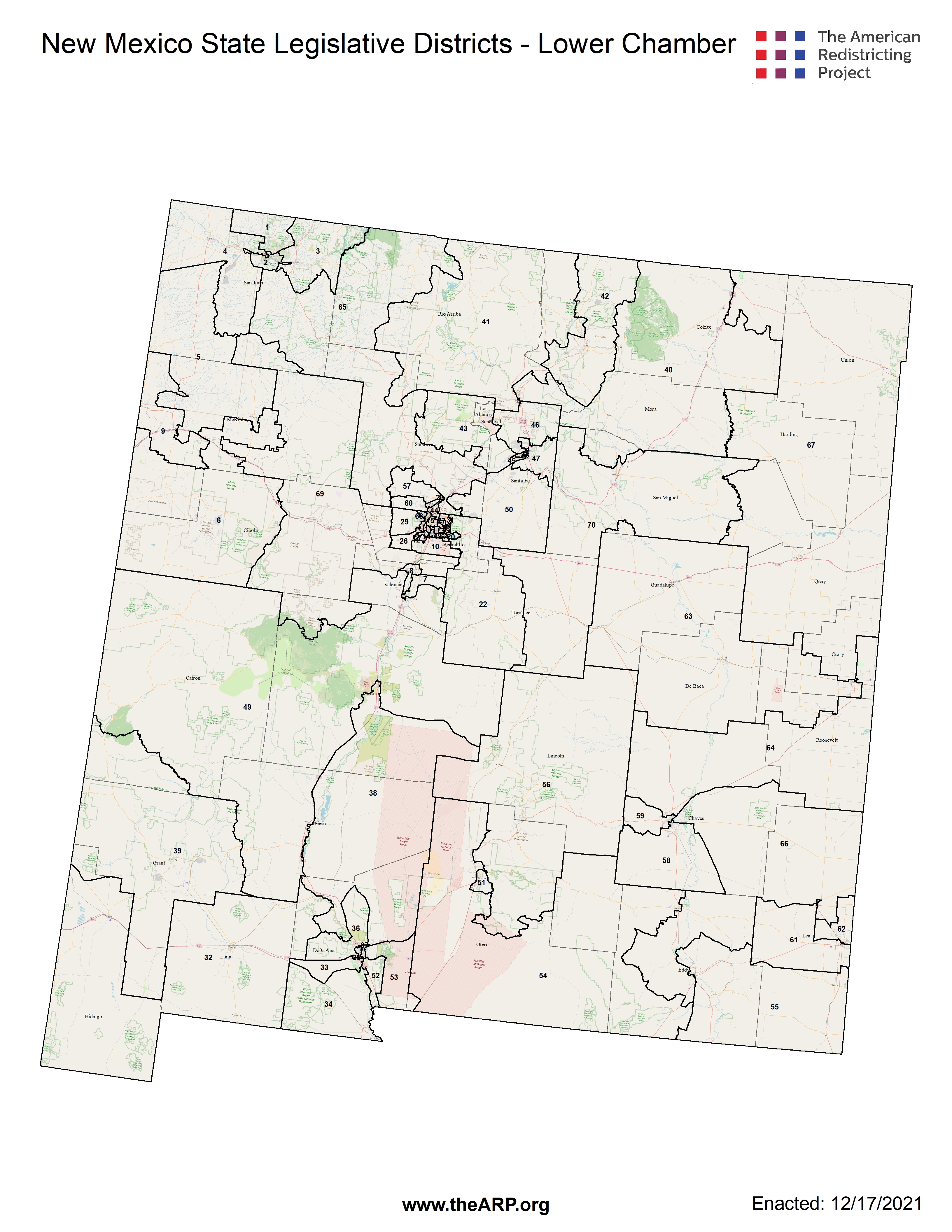
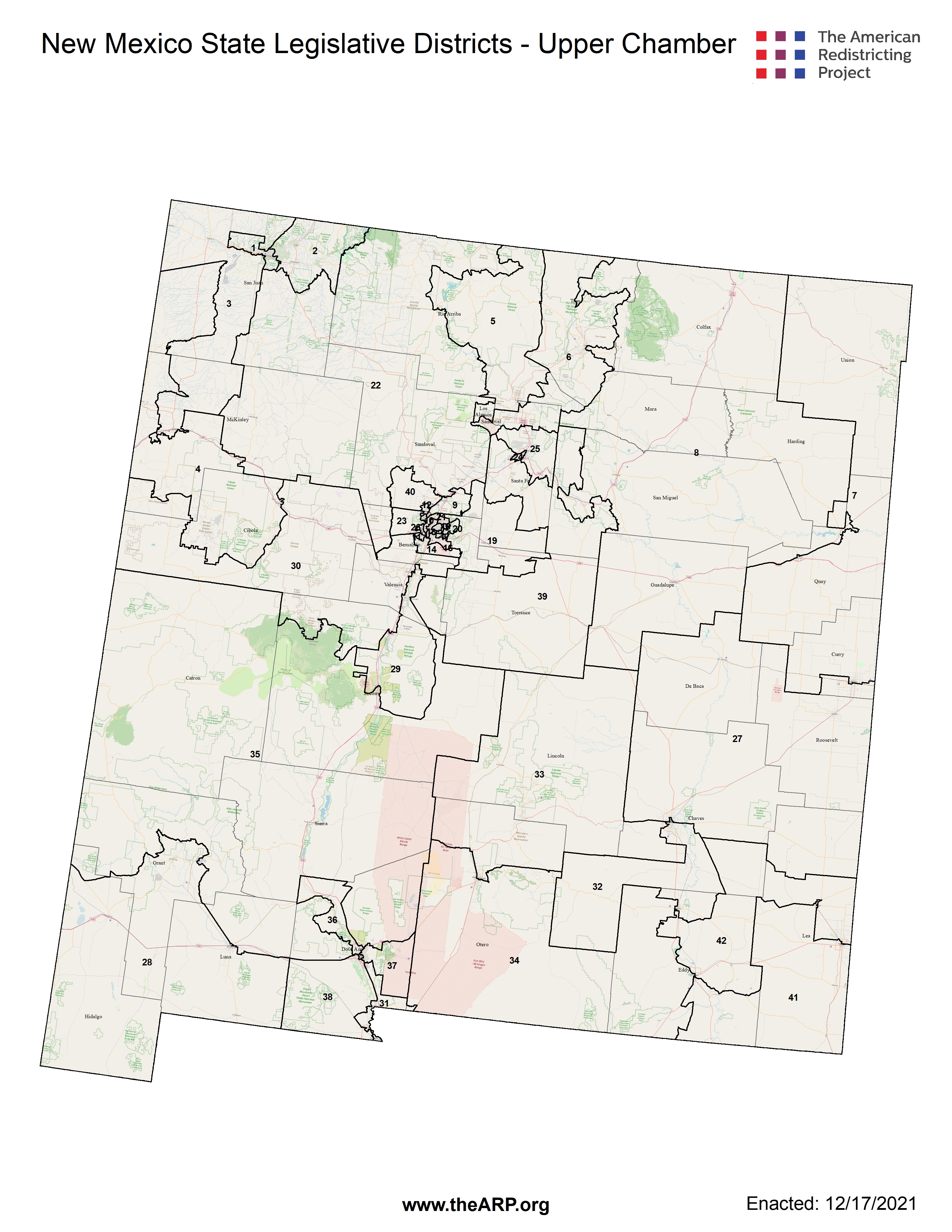
Congressional and Legislative maps are enacted by the New Mexico Legislature, subject to the Governor’s veto. A 7-member advisory commission, the Citizen Redistricting Committee, draws and submits at least 3 proposals for each type of plan to the Legislature, which is free to use, amend or reject them.
New Mexico’s congressional delegation remained at 3 seats following the 2020 reapportionment.
Primary Authority: Congressional and legislative maps are enacted by the New Mexico Legislature, subject to the Governor’s veto. The Legislature can override a veto with a 2/3 vote in each chamber. No party currently has a veto-proof majority in either chamber.
If a bill is presented to the governor during session, the governor has 3 days to sign or veto it; otherwise, it becomes law without signature. If the bill is delivered to the governor during the last 3 days of the session, the governor must sign or veto it within 20 days of session adjournment; otherwise, it is pocket vetoed. Sundays are excluded from these calculations.
Advisory Authority: New Mexico’s Citizen Redistricting Committee draws and proposes at least 3 congressional and legislative plans to the Legislature, which is free to use, amend, or reject them.
Mapping Timeline: After holding the required number of public hearings, the advisory Citizen Redistricting Committee must adopt its congressional and legislative plan proposals and submit them to the Legislature along with accompanying written evaluations and explanatory statements by September 1 of years ending in 1. The Legislature must adopt final congressional and legislative plans by the end of the calendar year in which the state received the decennial census results. [N.M. Const. art. IV, § 3; N.M. Stat. Ann. §§ 1-3A-5; 1-3A-8; 1-3A-9; 1-3-13]
Redistricting Criteria: There are no congressional or legislative redistricting criteria applicable to the New Mexico Legislature’s final plans. The following criteria are applicable only to the Citizen Redistricting Committee’s plan proposals:
Map Challenges: Not specified.
Types of Measures: Initiatives are not permitted to amend statutes or the state Constitution. Referendums are permitted on statutes. Legislatively initiated ballot measures may amend both statutes and the Constitution.
Single-Subject Rule: No.
Signature Requirements: The signature requirements for referendums is 10% of the qualified electors of each of ¾ of the counties and 10% of the qualified electors of the state, both calculated based on the number of votes cast at the last preceding general election. 714,754 people voted in the 2022 general election in New Mexico, so 71,476 signatures are required for a referendum. If the referendum petition receives signatures equal to 25% of the qualified electors of the state based on the last general election and those are submitted within the specified time period, the subject law is suspended pending the referendum vote.
Circulation Period: Referendums must be submitted no less than 4 months prior to the general election in which it is to appeal on the ballot (July 5, 2024). To suspend a law pending the referendum vote, the 25% of qualified elector signatures must be submitted to the Secretary of State within 90 days of the adjournment of the legislative session in which the law was passed.
Other Requirements: Both a majority of those voting on the question and at least 40% of qualified electors voting in that general election must vote to repeal the law for a referendum to be successful. Referendums may not target general appropriation laws; laws providing for the preservation of public peace, health, or safety; laws providing for the payment of public debt or interest, or otherwise creating or funding the same except as provided in the state constitution; laws relating to the maintenance of public schools or state institutions; or local or special laws.
2020
2010
2000
Current districts for New Mexico by chamber, shaded by the incumbent’s party.
To view past district shapefiles, see our Map Archive Page.