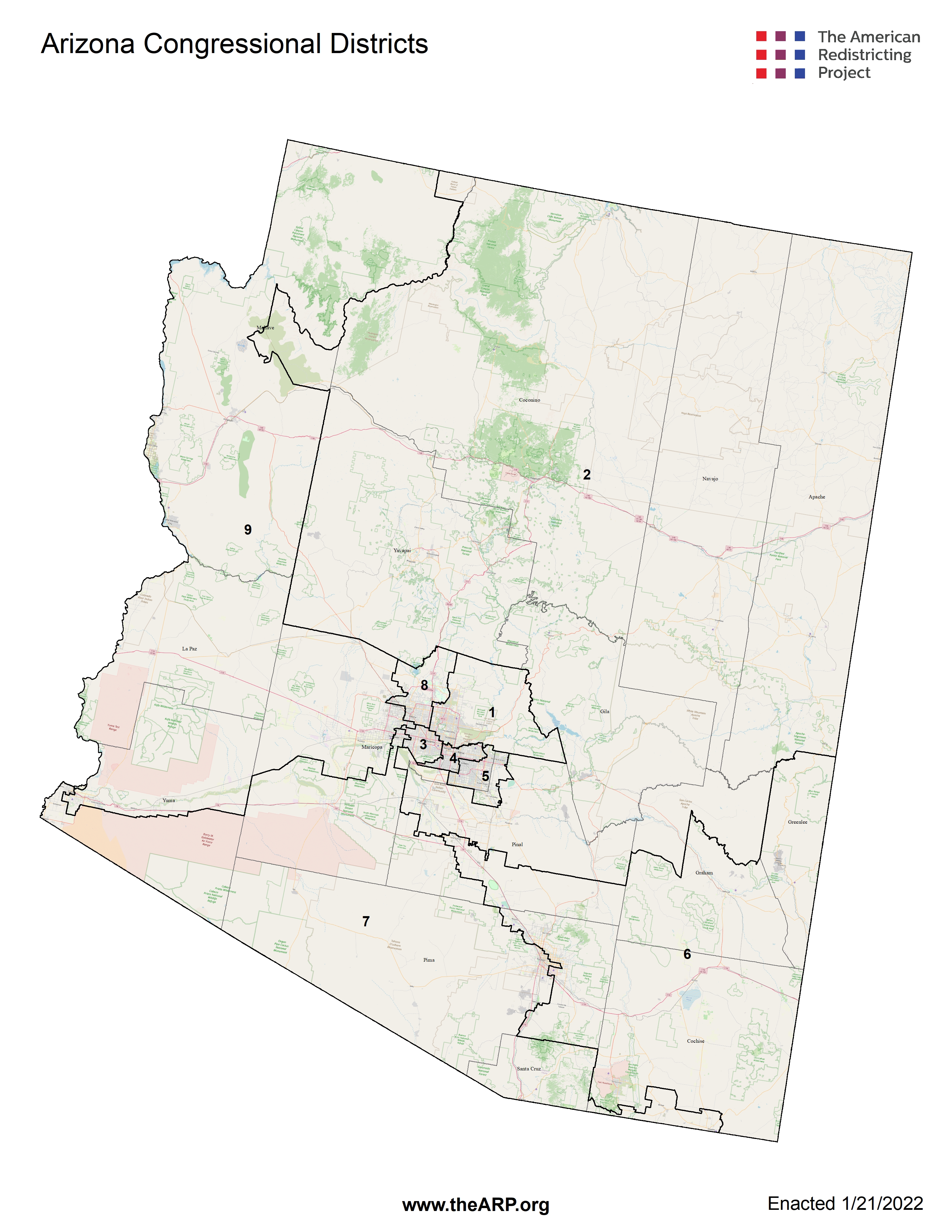
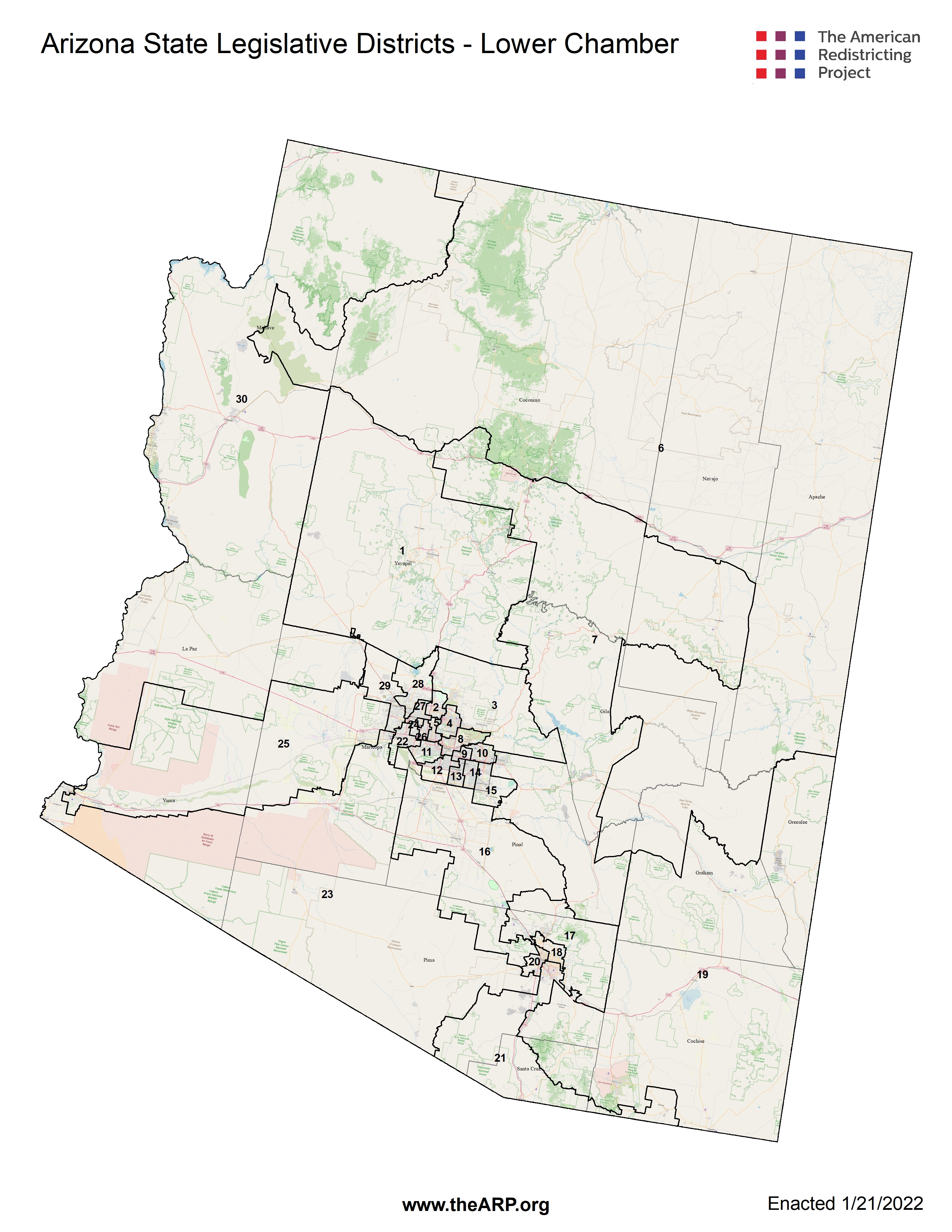
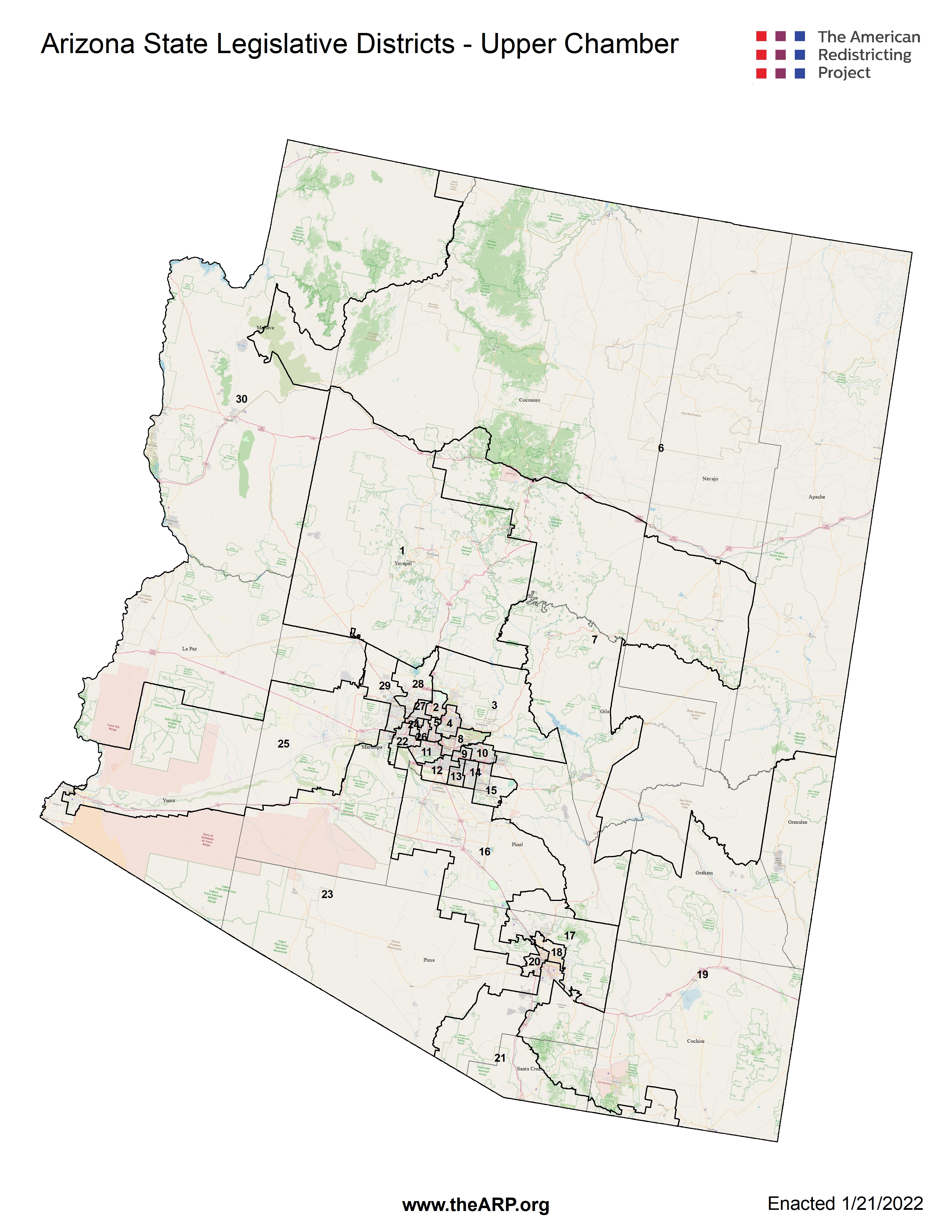
Congressional and legislative maps are drawn and adopted by the Arizona Independent Redistricting Commission, a politically appointed five-member body.
Arizona’s congressional delegation remained at 9 seats following the 2020 reapportionment.
Primary Authority: Congressional and legislative plans are drawn and adopted by the Arizona Independent Redistricting Commission, a politically appointed 5-member body.
Mapping Timeline: The Commission begins by creating grid-like districts of equal population across the state which are then adjusted to accommodate the state’s redistricting criteria. The Commission must release at least one draft congressional plan and one draft legislative plan to the public for a comment period of at least 30 days. During this period the Arizona State Legislature can make non-binding recommendations for the Commission’s consideration. After this period, the Commission establishes final congressional and legislative district boundaries and certifies them to the Secretary of State. [Ariz. Const. art. IV, pt. 2, §§ 1(14), (16), (17)]
Redistricting Criteria: Comply with U.S. Constitution and federal Voting Rights Act; Equal population to extent practicable; geographically compact; contiguous; respect communities of interest to extent practicable; use visible geographic features, city, town and county boundaries, and undivided census tracts to extent practicable; favor competitive districts to extent practicable if no significant detriment caused to other goals.
PROHIBITED: Party registration and voting history data for initial mapping (can be used for testing maps); considering incumbent/candidate residences. [Ariz. Const. art. IV, pt. 2, §§ 1(14), (15)]
Map Challenges: Venue not specified. The commission is explicitly given standing in legal actions regarding redistricting plans and the commission’s operations. [Ariz. Const. art. IV, pt. 2, § 1(20)]
Types of Measures: Direct initiatives and referendums are permitted to amend statutes. Direct initiatives are permitted to amend the state constitution. Legislatively initiated ballot measures may amend both statutes and the state constitution.
Single-Subject Rule: Yes for constitutional amendments; no for statutory initiatives.
Initiative Subject Restrictions: Referendums may not repeal laws “immediately necessary for the preservation of the public peace, health, or safety, or for the support and maintenance of the departments of the State Government and State institutions[.]”
Signature Requirements: Constitutional amendments require signatures equal to 15% of all votes cast for all candidates for governor in the last general election, 10% for all other initiatives, and 5% for a veto referendum. 2,559,485 people voted for a gubernatorial candidate in the 2022 general election in Arizona, so 383,923 signatures are required for constitutional amendments; 255,949 signatures are required for any other initiative, and 127,975 signatures are required for a veto referendum.
Submission Deadlines: Initiative petitions must be submitted at least four months prior to the election in which the petition is to appear on the ballot (July 4, 2024). Referendums must be submitted within 90 days after the adjournment of the legislature.
Circulation Period: The circulation period for initiative petitions is 24 months.
Ballot Title and Summary: Proponents write the caption and the Secretary of State drafts the summary, subject to approval by the Attorney General. Expedited reviews for titles and summaries are not permitted.
Other Requirements: A fiscal impact statement is required. Circulators are required to be qualified to register to vote. There are no supermajority requirements. The legislature can only amend the approved measure if the change is in line with the aim of the measure and approved by a ¾ majority in the legislature. Initiatives are permitted on general election ballots, but not on primary or special election ballots or odd-year ballots.
[Ariz. Const. art. IV, pt. 1, § 1; Ariz. Rev. Stat. §§ 19-101 — 19-161; Ariz. Sec. of State Website]
2020
2010
2000
Current districts for Arizona by chamber, shaded by the incumbent’s party.
To view past district shapefiles, see our Map Archive Page.