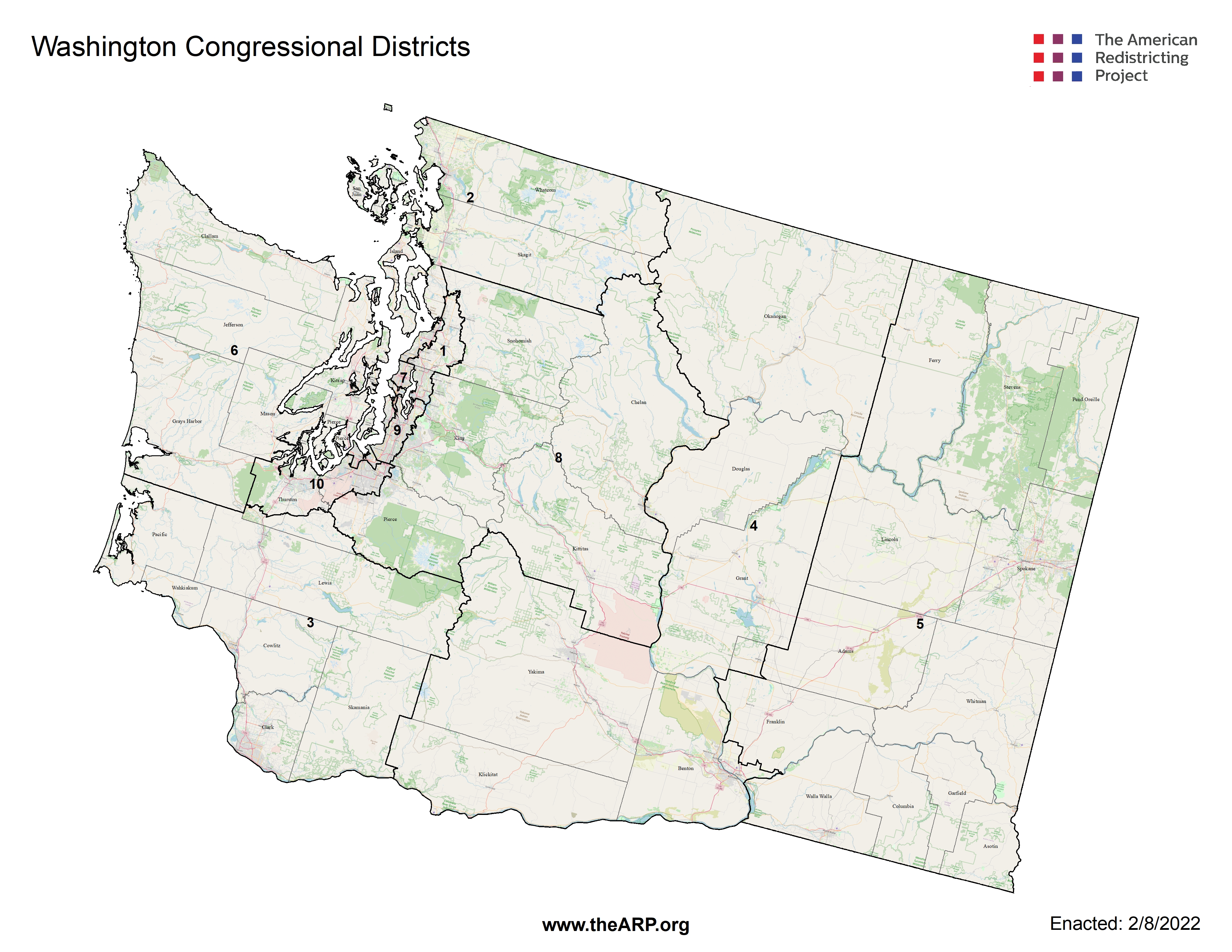
Congressional and legislative plans are drawn and adopted by the Washington State Redistricting Commission, a 5-member, politically appointed body. The Washington State Legislature has an opportunity to make limited amendments to the Commission’s plans after adoption.
Washington’s congressional delegation remained at 10 seats following the 2020 reapportionment.
Primary Authority: Congressional and legislative plans are drawn by the Washington State Redistricting Commission, a 5-member, politically appointed body. The Washington State Legislature has an opportunity to make limited amendments the Commission’s adopted plans (changing no more than 2% of the population of any given district) by a 2/3 vote in each chamber before they become effective.
Backup Authority: If the Commission fails to adopt and submit its final plans to the Legislature by its deadline, the Washington Supreme Court adopts the necessary plan(s). [Wash. Const. art. II, § 43(6); Wash. Rev. Code § 44.05.100(4)]
Mapping Timeline: The Commission must adopt and submit its final redistricting plans to the Legislature as soon as possible following the decennial census but no later than November 15 of years ending in 1. The Legislature has until the 30th day of the first regular or special session convened after the submission of plans to pass amendments thereon; after that date, the plans with any successful amendments, if any, become legally effective. If the Commission fails to adopt and submit final plans by its deadline, the Washington Supreme Court must adopt the necessary plan(s) by April 30 of years ending in 2.
The Legislature can, at any time, reconvene the Commission for the purpose of modifying a redistricting plan with a 2/3 vote in each chamber. Modifications are subject to the same procedural and substantive requirements as initial plans, including the Legislature’s opportunity to make amendments to the Commission’s adopted modifications. [Wash. Const. art. II, § 43(6)–(8); Wash. Rev. Code §§ 44.05.100; 44.05.120]
Redistricting Criteria: As nearly equal in population as practicable, excluding nonresident military personnel. To the extent reasonable, districts must be: Contiguous (not contiguous if separated by geographic boundaries or artificial barriers that prevent intra-district transportation); Compact and convenient; and Divided by natural geographic barriers, artificial barriers, or political subdivision boundaries. Insofar as practical, districts should: Minimize divisions of counties and municipalities; Coincide with local political subdivision boundaries and recognized communities of interest; and Keep precincts whole.
PROHIBITED: Drawn purposefully to favor or discriminate against any political party or group. [Wash. Const. art. II, § 43(5); Wash. Rev. Code § 44.05.090]
Map Challenges: After a plan or plan modification takes effect, any registered voter can file a petition in the Washington Supreme Court to challenge it. [Wash. Const. art. II, 43(10); Wash. Rev. Code § 44.05.130]
Types of Measures: Direct and indirect initiatives are permitted to amend statutes, but not the state constitution. Referendums are permitted to amend statutes. Legislatively initiated ballot measures may amend both statutes and the state constitution.
Single-Subject Rule: Yes.
Initiative Subject Restrictions: Initiatives cannot grant divorce or give extra compensation to public employees.
Signature Requirements: Statutory initiatives require signatures equal to 8% of all votes cast for all candidates for Governor in the previous gubernatorial election, and 4% for veto referendums. 4,056,454 people voted for a gubernatorial candidate in the 2020 general election in Washington, so 324,517 are required for statutory initiatives and 162,259 for veto referendums.
Submission Deadlines: Direct initiatives must be submitted no less than 4 months prior to the election in which it is to appear on the ballot (July 5, 2024). Indirect initiatives must be submitted no less than 10 days prior to the convening of the regular session of the Legislature. Referendums must be submitted within 90 days after the adjournment of the legislative session in which the subject law was passed.
Circulation Period: No explicit circulation period is specified, but initial filing and submission dates mean that direct initiatives have a period of 6 months minus 10 days and indirect initiatives have a period of 10 months.
Ballot Title and Summary: The ballot title and summary are written by the proponents and certified by the Secretary of State. Expedited reviews for titles and summaries are permitted.
Other Requirements: A fiscal impact statement is required. Measures that would permit gambling or a lottery require a 60% supermajority. For 2 years after the approval of a statutory initiative by the people, the Legislature can only amend or repeal it with a 2/3 supermajority vote in both chambers. Measures amended in this way cannot be targeted by referendums. Referendums cannot target emergency laws or laws necessary for the support of the state government and its existing public institutions. Initiatives are permitted on general election ballots but not on primary, special, or odd-year election ballots.
[Wash. Const. art. II, §§ 1, 41; Wash. Rev. Code §§ 29A.72.010–29A.72.290; Washington Secretary of State Elections Website]
2020
2010
2000
Current districts for Washington by chamber, shaded by the incumbent’s party.
To view past district shapefiles, see our Map Archive Page.
Consolidated with Palmer v. Hobbs