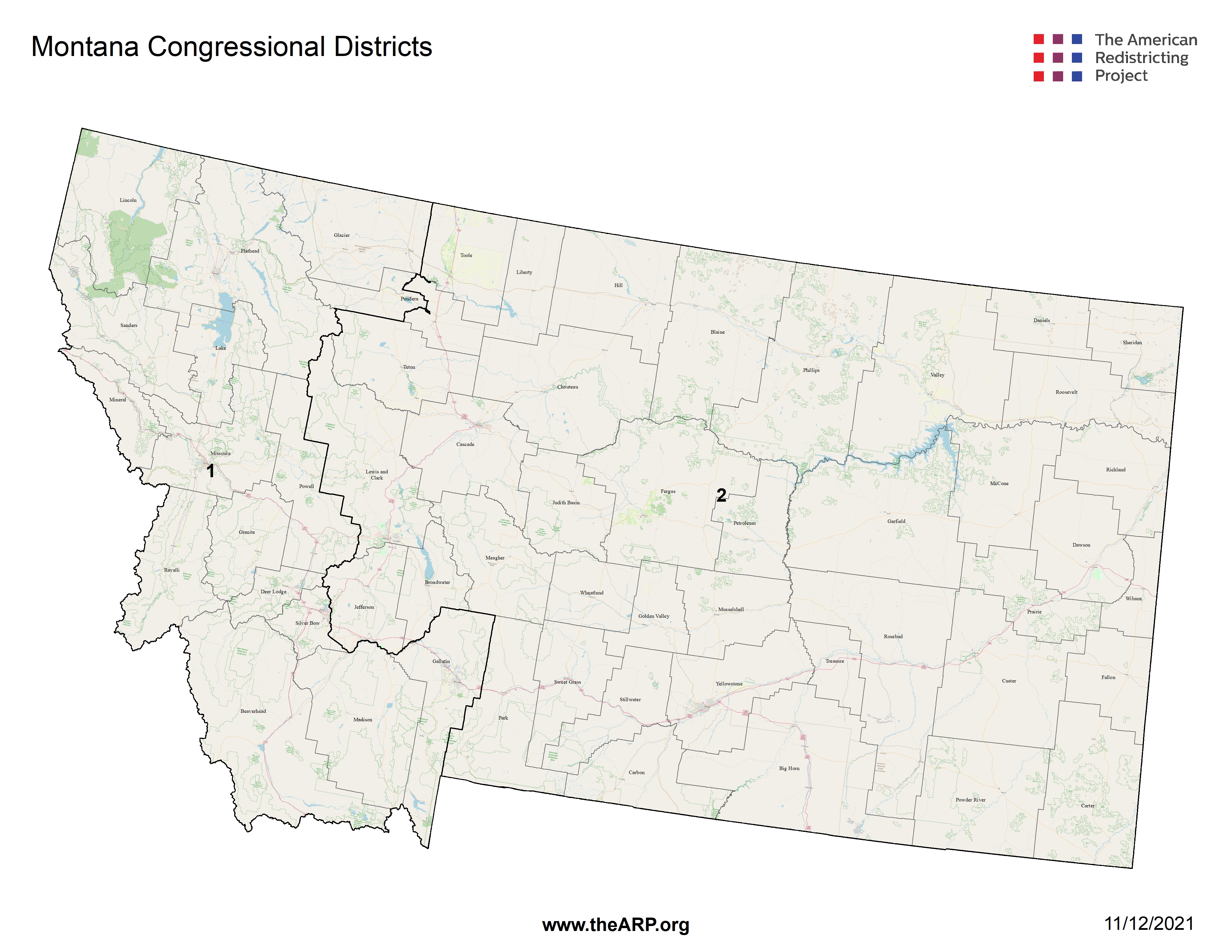
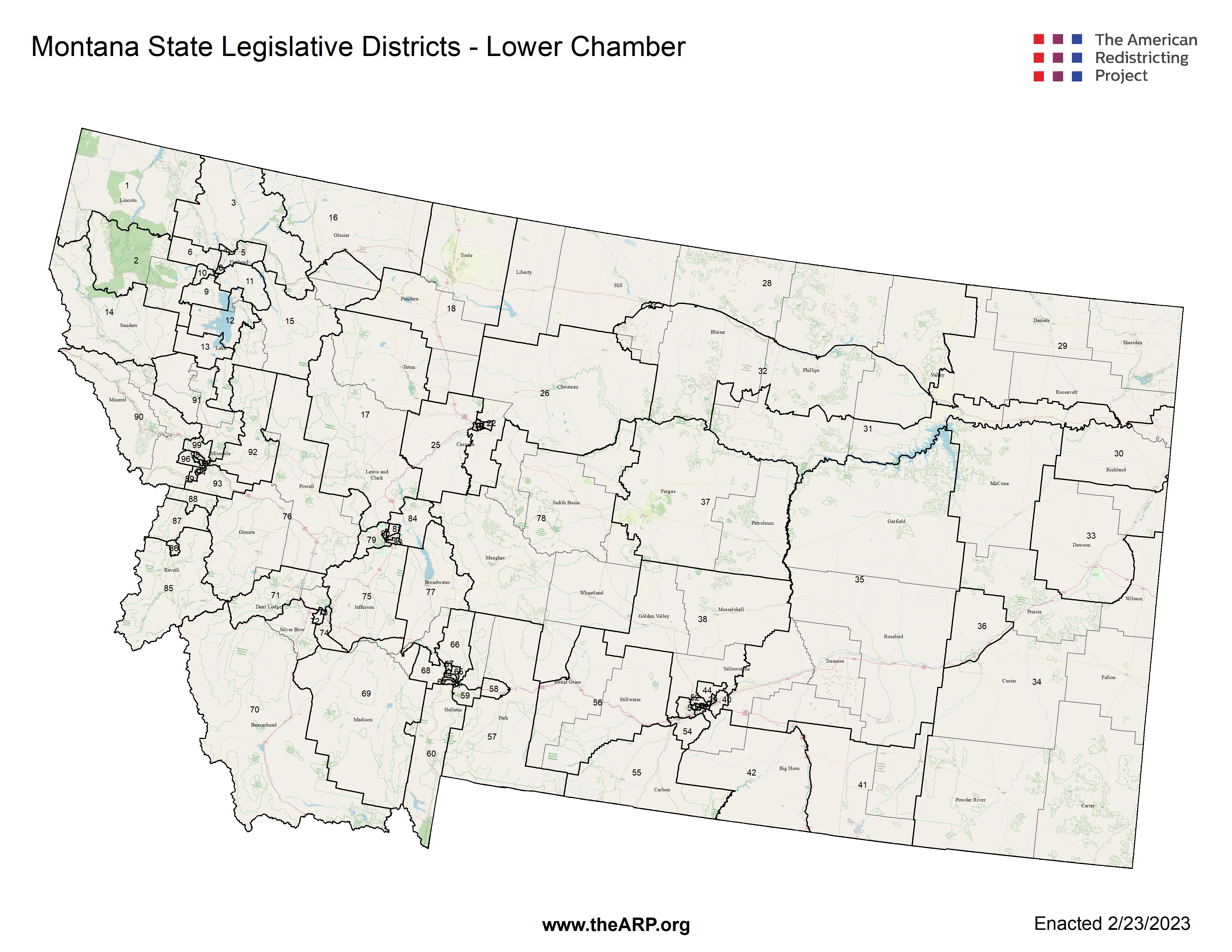
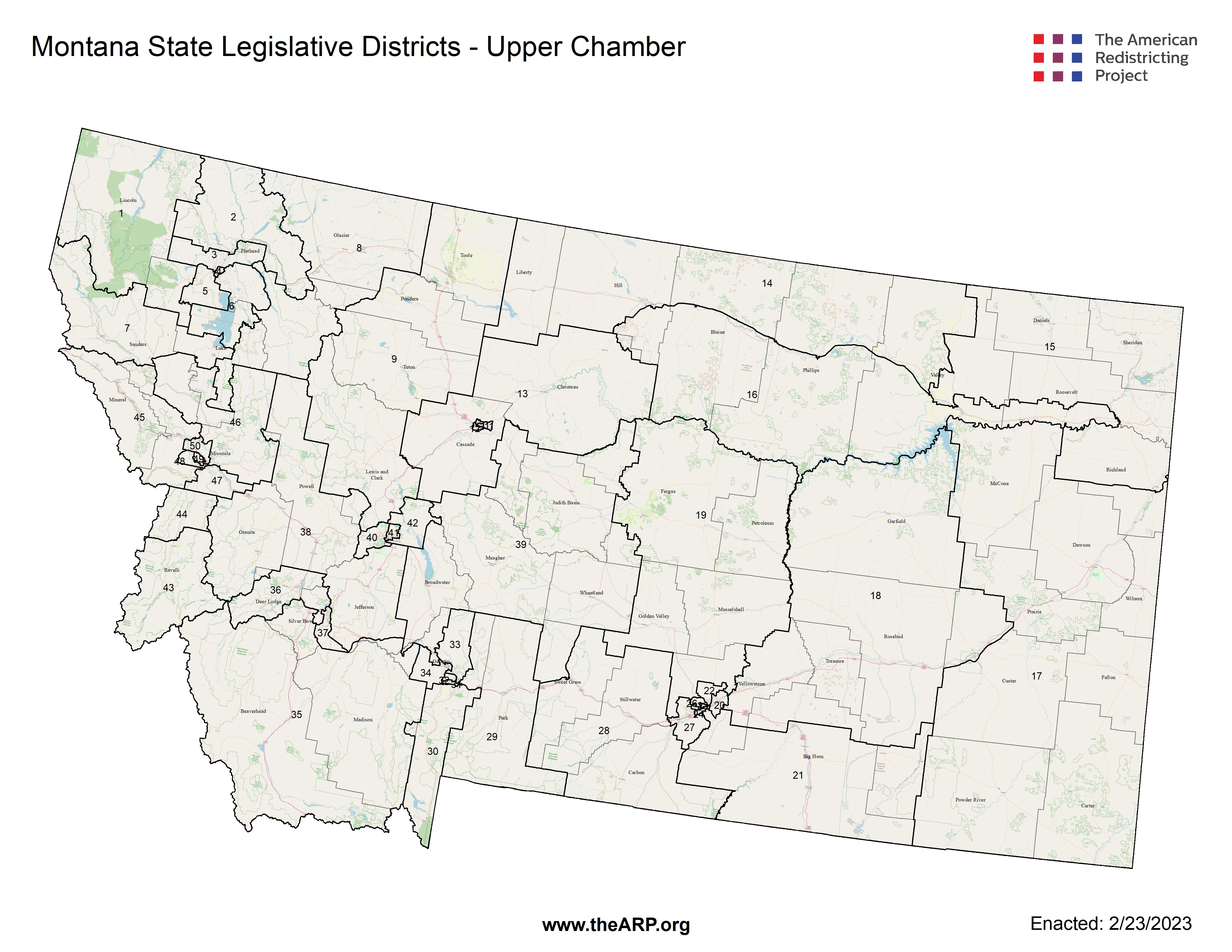
Congressional and legislative plans are drawn and adopted by the Montana Districting and Apportionment Commission, a 5-member, politically appointed body. The Montana Legislature has an opportunity to make non-binding recommendations to the Commission on its legislative plans.
Montana’s congressional delegation grew from 1 seat to 2 (a gain of 1 seat) following the 2020 reapportionment.
Primary Authority: Congressional and legislative maps are drawn and adopted by the Montana Districting and Apportionment Commission, a 5-member, politically appointed body. The Montana Legislature has an opportunity to provide recommendations regarding the Commission’s legislative plan, which the Commission is free to adopt or reject.
Mapping Timeline: The Commission must hold at least 1 public hearing on a congressional plan before adopting it as final and must file its final adopted congressional plan with the Secretary of State within 90 days of decennial census data becoming available. The Commission must hold at least 1 public hearing on a legislative plan prior to submitting it to the Legislature and it must be submitted by the 10th legislative day of the 1st regular session after the Commission’s appointment or after decennial census data is available. The Legislature must return the plan with its recommendations to the Commission within 30 days of its submission, and the Commission then has 30 days to adopt and file its final legislative plan with the Secretary of State. [Mont. Const. art. V, § 14; Mont. Code Ann. §§ 5-1-108, 5-1-109, 5-1-110, 5-1-111]
Redistricting Criteria:
Map Challenges: Not specified.
Types of Measures: Direct initiatives and referendums are permitted to amend statutes. Direct initiatives are permitted to amend the state constitution. Legislatively initiated ballot measures may amend both statutes and the constitution.
Single-Subject Rule: No, but there is a separate vote requirement.
Initiative Subject Restrictions: Initiatives cannot contain appropriations or special or local legislation.
Signature Requirements: Constitutional Amendments require 10% of the qualified electors of the state, including at least 10% of the qualified electors in each of at least 2/5 of the state’s legislative districts. All other initiatives and veto referendums require 5% of the qualified electors of the state, including at least 5% of the qualified electors in each of at least 1/3 of the state’s legislative districts. Qualified electors is determined by the number of votes cast for gubernatorial office in the preceding general election in Montana. 603,587 people voted for a gubernatorial candidate in the 2020 election, so 60,359 are required for constitutional amendments and 30,180 for any other initiatives and veto referendums. District specific information can be found here.
Submission Deadlines: Initiative petitions must be submitted to the county election administrators for the district where those signatures were gathered no later than 4 weeks before the final deadline for election administrators to file certified petitions with the Secretary of State (June 21, 2024). County election administrators must file certified initiative petitions with the Secretary of State no later than 5:00 p.m. of the 3rd Friday of the 4th month prior to the election in which the measure will be voted upon (July 19, 2024). Referendums must be submitted no later than 6 months after the end of the legislative session in which the act was passed.
Circulation Period: The circulation period for initiative petitions is 1 year.
Ballot Title and Summary: The ballot title and summary are written by the proponent and are identical. Expedited reviews for titles and summaries are permitted.
Other Requirements: A fiscal impact statement is required if the proposed ballot measure would affect revenue, expenditures, or the fiscal liability of the state. Circulators are required to be a resident of the state. There are no supermajority requirements. The Legislature can amend or repeal voter-approved statutes but must follow constitutional guidelines to amend or repeal a constitutional amendment by sending the Legislature’s proposal to voters by a 2/3 vote in each chamber. Referendums cannot target appropriations of money. Initiatives are permitted on general election ballots but not on primary, special, or odd-year election ballots.
[Mont. Const. art. III, §§ 4, 5; art. V, § 11; art. XIV, §§ 1 – 11; Mont. Code Ann. §§ 13-27-101 – 13-27-504; Montana Ballot Issues Website]
2020
2010
2000
Current districts for Montana by chamber, shaded by the incumbent’s party.
To view past district shapefiles, see our Map Archive Page.