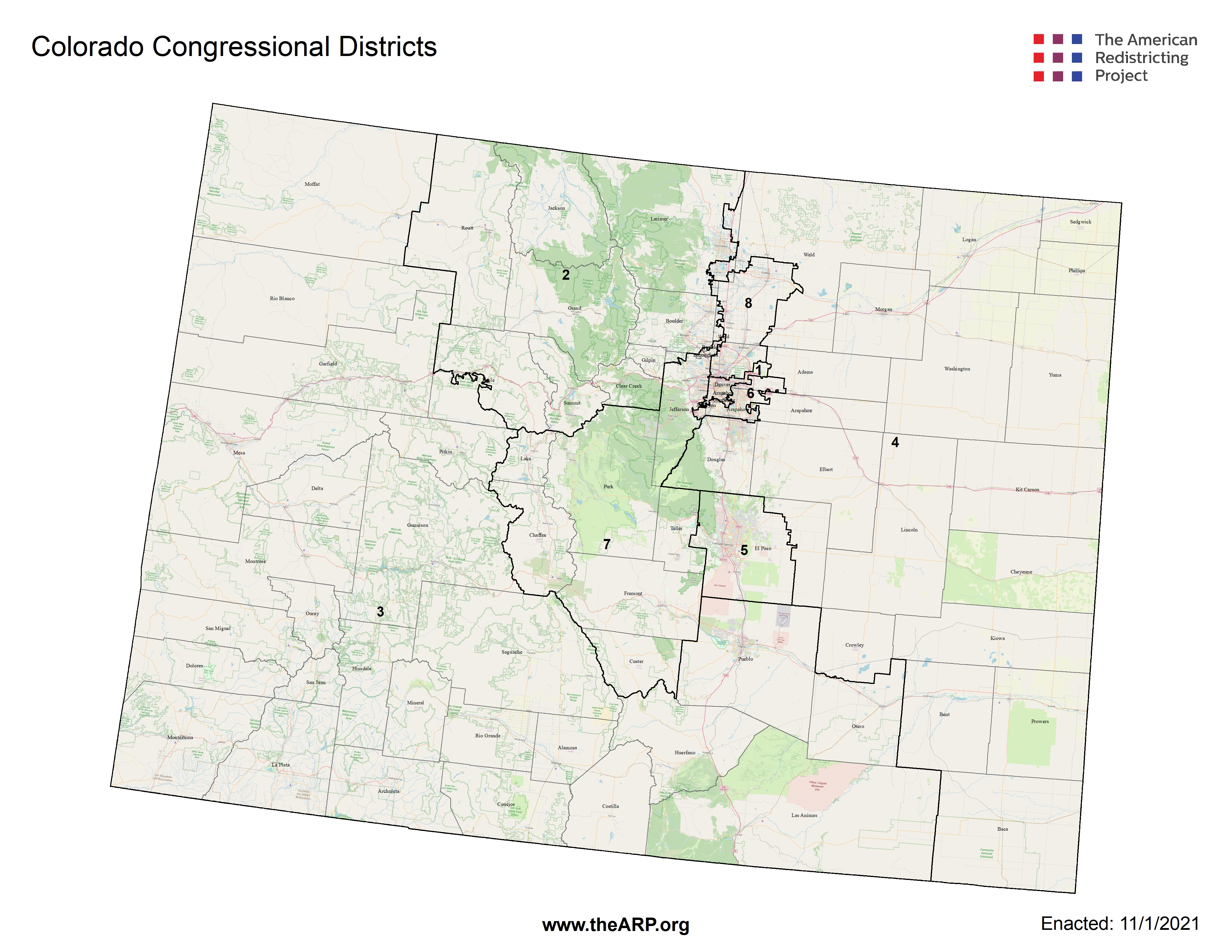
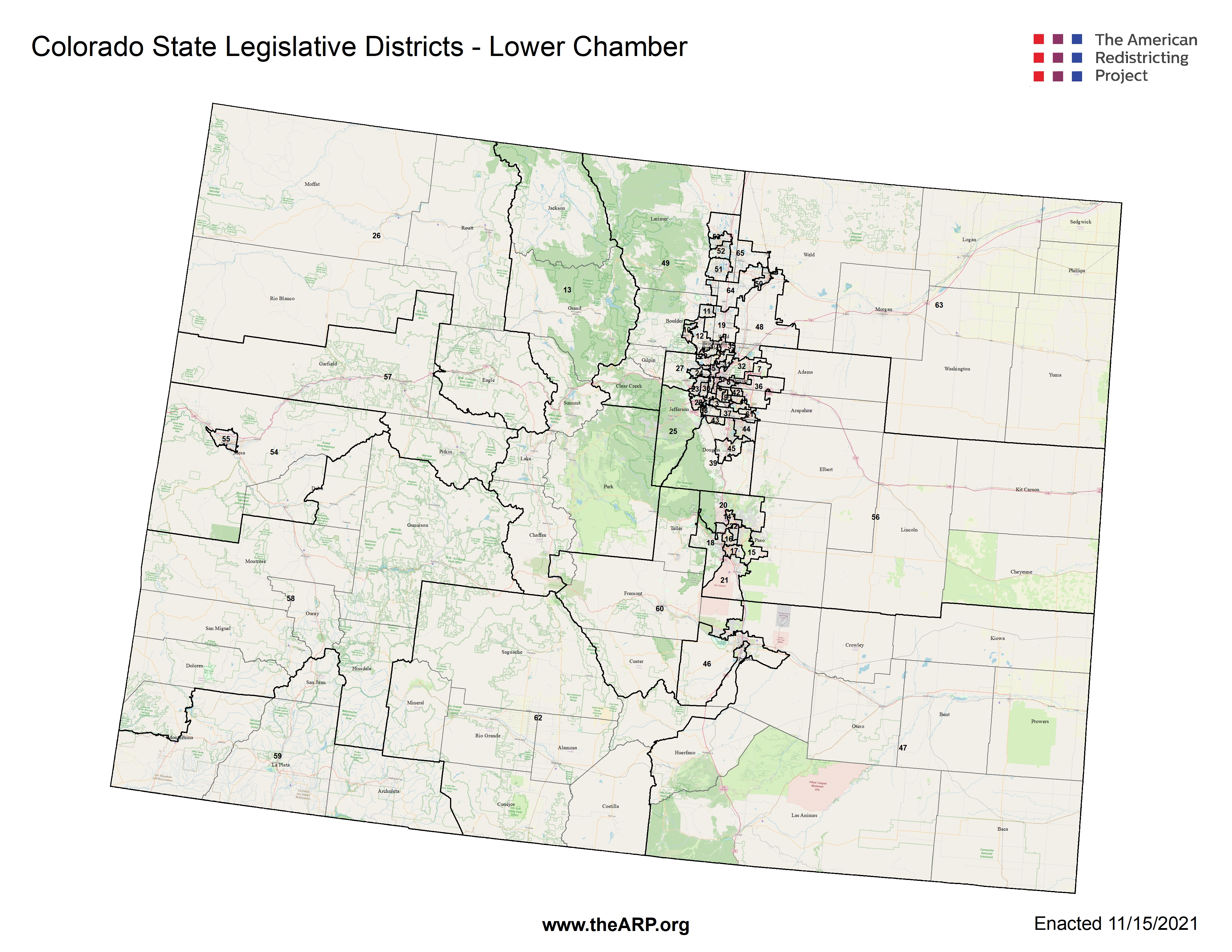
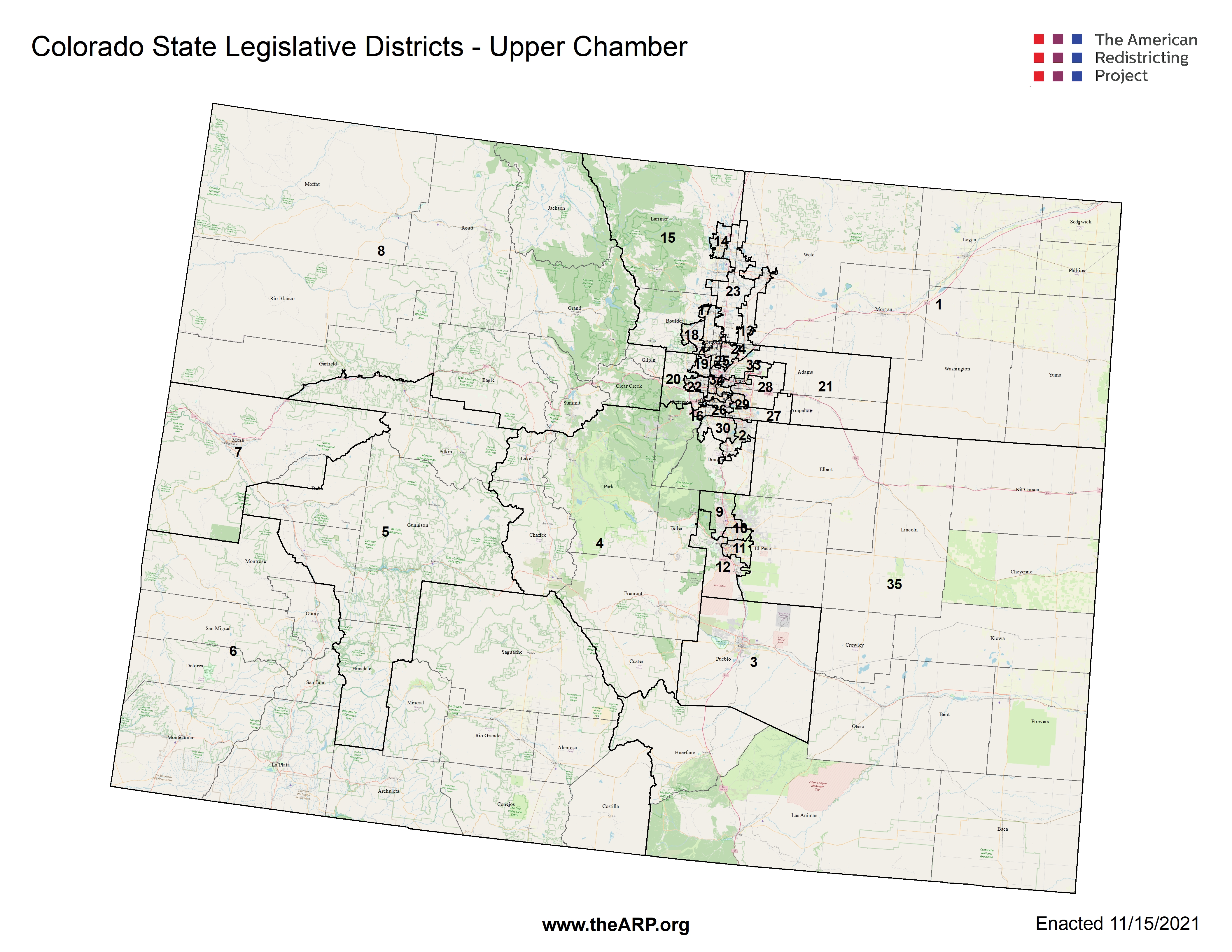
Congressional maps are adopted by the state's Independent Congressional Redistricting Commission and legislative maps are adopted by the state's Independent Legislative Redistricting Commission.
Colorado’s congressional delegation grew from 7 seats to 8 (a gain of 1 seat) following the 2020 reapportionment.
Primary Authority: Congressional plans are drawn and adopted by Colorado's Independent Congressional Redistricting Commission, a 12-member body of citizen-applicants.
Mapping Timeline: Nonpartisan staff draws and presents a “preliminary plan” between 30 and 45 days after the commission has convened or the necessary census data are available, whichever is later. Public hearings on the preliminary plan must be completed by July 7 of the redistricting year. Nonpartisan staff then prepares at least 3 “staff plans” and presents them to the commission and public in sequential order according to a timeline established by the commission. Each staff plan must be published online at least 24 hours in advance of being presented to the commission, and there must be at least 10 days between the presentation of each staff plan. The commission can adopt a final plan at any point after the first staff plan has been presented but must adopt one no later than September 1 of the redistricting year, which is then submitted to the Colorado Supreme Court for review. If the commission misses its deadline, the third staff plan is submitted. [Colo. Const. art. V, § 44.4]
Redistricting Criteria: Good-faith effort to achieve precise mathematical population equality with each variance justified; Contiguous; Preserve political subdivisions and communities of interest as much as is reasonably possible; As compact as reasonably possible; Maximize competitive districts to extent possible.
PROHIBTED: Protecting incumbents, candidates, or any political party; Intending or resulting in the denial, abridgment, or dilution of any person’s right to vote on account of their race or membership in a language minority group. [Colo. Const. art. V, § 44.3]
Map Challenges: The Colorado Supreme Court automatically reviews an adopted congressional plan and must approve or return it by November 1 of the redistricting year. If its returned, the commission must hold hearings and adopt a revised plan within 12 days and submit it to the court again. If it fails to do so, the nonpartisan staff has 3 days to prepare and submit a revised plan. The Court must approve a final plan no later than December 15 of the redistricting year, which becomes effective upon filing with the Secretary of State. [Colo. Const. art. V, § 44.5]
Primary Authority: Legislative plans are drawn and adopted by Colorado's Independent Legislative Redistricting Commission, a 12-member body of citizen-applicants.
Mapping Timeline: Same timeline as congressional commission, except that public hearings on the preliminary plans must be completed by July 21 of the redistricting year and final plans must be adopted no later than September 15 of the redistricting year. [Colo. Const. art. V, § 48.2]
Redistricting Criteria: Same criteria as congressional plans except for an explicit +/- 5% deviation population range amongst state House and Senate districts. [Colo. Const. art. V, § 48.1]
Map Challenges: Same procedures as congressional plans, except the Court must approve or return the commission’s final plans by November 15 of the redistricting year and final plans must be approved no later than December 29 of the redistricting year. [Colo. Const. art. V, § 48.3]
Types of Measures: Direct initiatives and referendums are permitted to amend statutes. Direct initiatives are permitted to amend the state constitution. Legislatively initiated ballot measures may amend the state constitution, but not statutes.
Single-Subject Rule: Yes.
Initiative Subject Restrictions: No.
Signature Requirements: Constitutional amendments, initiatives, and veto referendums require 5% of all votes cast for all candidates for Secretary of State in the last general election. Constitutional amendments also require signatures be collected from at least 2% of the registered voters in each state Senate district. 2,508,830 people voted for a Secretary of State candidate in the 2022 general election in Colorado, so 125,442 signatures are required for constitutional amendments, initiatives, and veto referendums.
Submission Deadlines: Initiative petitions must be submitted at least three months prior to the election in which the petition is to appear on the ballot (August 4, 2024). Referendums must be submitted within 90 days after the adjournment of the legislature.
Circulation Period: The circulation period for initiative petitions is 6 months.
Ballot Title and Summary: The Title Board prepares the title and the director of research for the legislative council prepares an impartial voter information pamphlet with an abstract of the fiscal impact study and arguments for and against the measure. Expedited reviews for titles and summaries are permitted.
Other Requirements: A fiscal impact statement is required. Circulators are required to be a citizen of the United States, at least 18 years old, and a Colorado resident. Constitutional amendments require 55% of the vote to pass. The General Assembly can amend or repeal statutory initiatives by a simple majority and can refer constitutional amendments to the voters by a 2/3 supermajority vote. Referendums may not affect appropriations for the support and maintenance of the Departments of State and state institutions or emergency legislation. Initiatives are permitted on general election and odd-year ballots, but not on primary or special election ballots.
[Colo. Const. art. V; Colo. Rev. Stat. §§ 1-40-101 — 1-40-136; Colorado General Assembly Website]
2020
2010
2000
Current districts for Colorado by chamber, shaded by the incumbent’s party.
To view past district shapefiles, see our Map Archive Page.