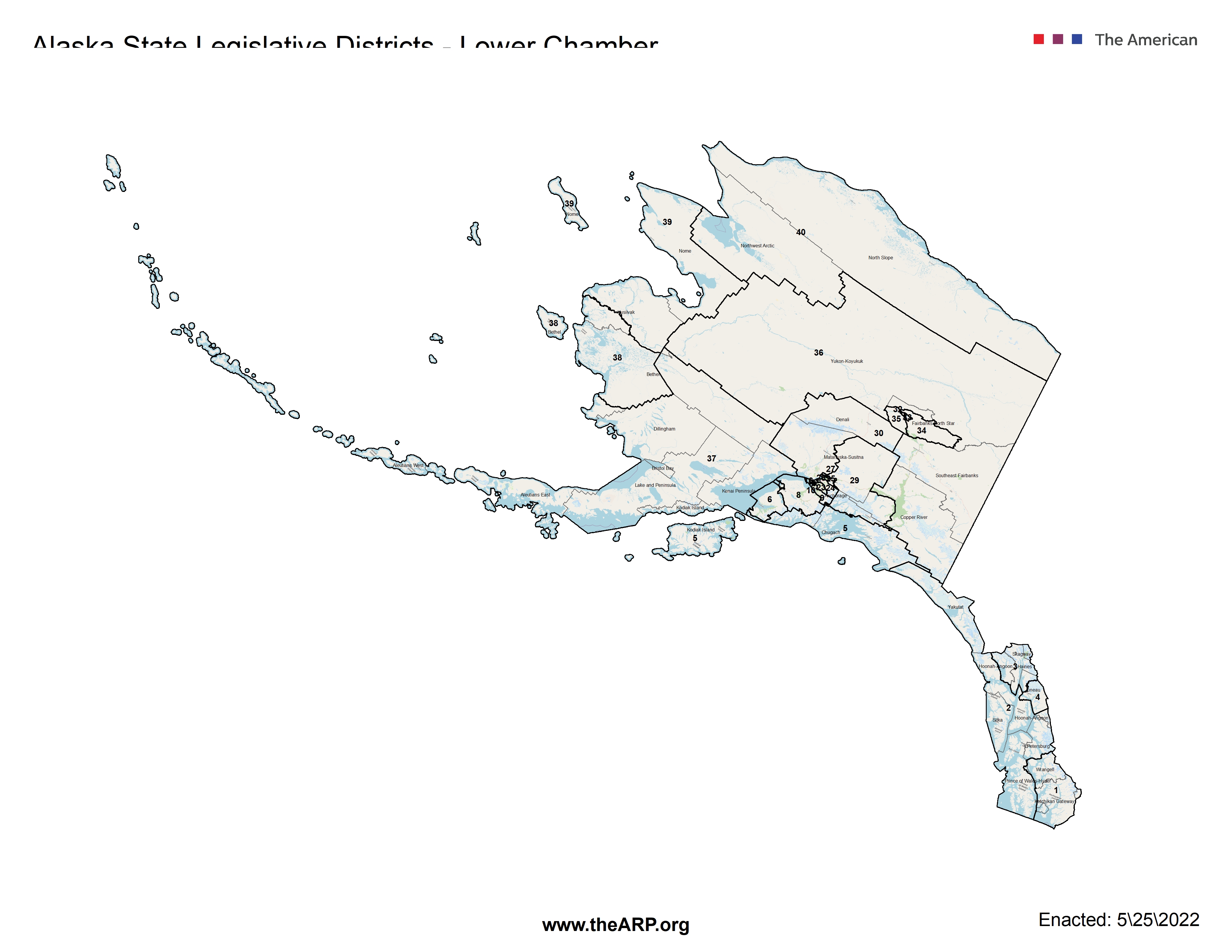
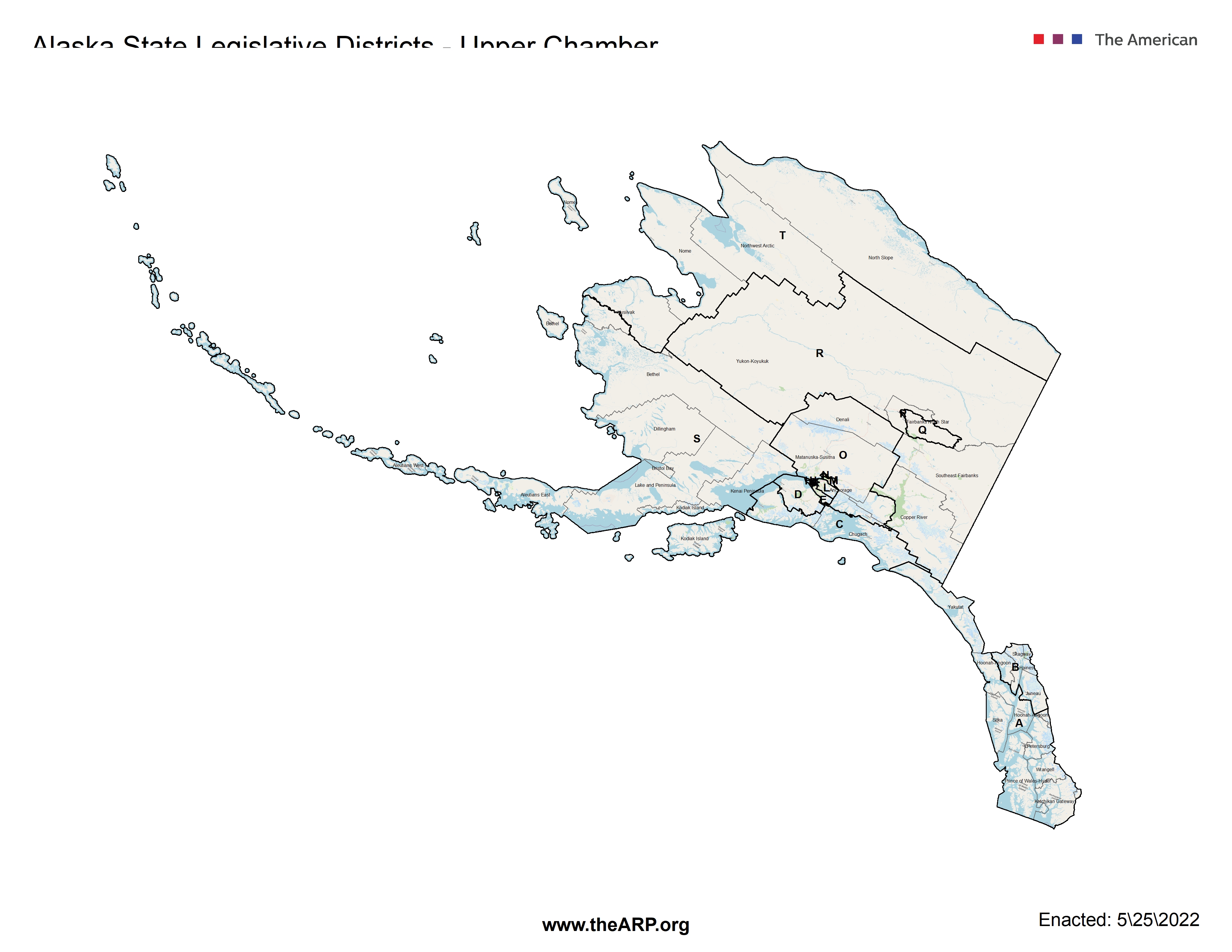
As of the 2020 Census, Alaska only has one at-large congressional district. The Alaska Redistricting Board, a politically appointed five-member body, draws the state legislative districts.
Alaska’s congressional delegation remained at 1 seat following the 2020 reapportionment.
As of the 2020 Census, Alaska has only one at-large congressional district.
Primary Authority: Legislative plans are drawn and adopted by the Alaska Redistricting Board, a politically appointed 5-member body.
Mapping Timeline: The Board must adopt one or more proposed redistricting plans within 30 days of the official reporting of the decennial census or 30 days of being appointed, whichever occurs last. Public hearings must be held on all proposed plans. The Board must adopt a final redistricting plan and issue a proclamation of redistricting no later than 90 days after members were appointed and the official reporting of the decennial census. Mid-decade redistricting is expressly prohibited. [Alaska Const. art. VI, § 10]
Redistricting Criteria:
Map Challenges: Challenges must be filed in the Alaska Superior Court and appeals go directly to the Alaska Supreme Court. Any qualified voter can petition the Superior Court to compel the Board to perform its duties or correct any error in a redistricting plan. Applications to compel the Board to perform a duty must be filed no later than 30 days after the expiration of the 90-day period for adopting a final plan. Applications to compel correction of any error in a redistricting plan must be filed within 30 days of the adoption and proclamation of the final plan. If a final decision declares a plan invalid, the matter must be returned to the Board for correction and development of a new plan. If that new plan is declared invalid, the matter may be referred to the Board again. [Alaska Const. art. VI, § 11]
Types of Measures: Indirect initiatives and referendums are permitted to amend statutes. Initiatives may not amend the state constitution. Legislatively initiated ballot measures may amend the state constitution, but not statutes.
Single-Subject Rule: Yes.
Initiative Subject Restrictions: No revenue measures; appropriations; acts affecting the judiciary; local or special legislation; or laws affecting peace, health, or safety.
Signature Requirements: 100 preliminary signatures are required. The signature requirements for both statutory initiatives and referendums is 10% of all votes cast in the last general election. Signatures must come from residents in at least 3/4 of Alaska's state House districts, including at least 7% of the total votes cast in each of those state House districts during the preceding general election. 267,047 people voted in the 2022 General Election in Alaska, so 26,705 signatures are required for both statutory initiatives and referendums. District information can be found here.
Submission Deadlines: Initiative petitions must be submitted prior to the Legislature’s convening in the year the petition is to appear on the ballot. Referendums must be submitted within 90 days of the adjournment of the legislative session.
Circulation Period: The circulation period for initiative petitions is one year.
Ballot Title and Summary: Both are written by the Lieutenant Government with help from the Attorney General. Expedited reviews for titles and summaries are permitted.
Other Requirements: A fiscal impact statement is required. Circulators must be United States citizens, at least 18 years old, and an Alaska resident. There are no supermajority requirements. The legislature cannot repeal an approved measure until two years have passed since its approval. Measures can be amended without time restrictions through a majority vote. Appropriations cannot be repealed. Initiatives are permitted on general, primary, and special election ballots, but not on odd-year ballots.
[Alaska Const. art. XI; Alaska Stat. §§ 15.45.010 — 15.45.465; Alaska Admin. Code tit. 6, § 25.240; Alaska Division of Elections]
2010
2000
Current districts for Alaska by chamber, shaded by the incumbent’s party.
To view past district shapefiles, see our Map Archive Page.
As of the 2020 U.S. Census, Alaska has only one at-large congressional district. The Alaska Redistricting Board draws the state legislative districts.