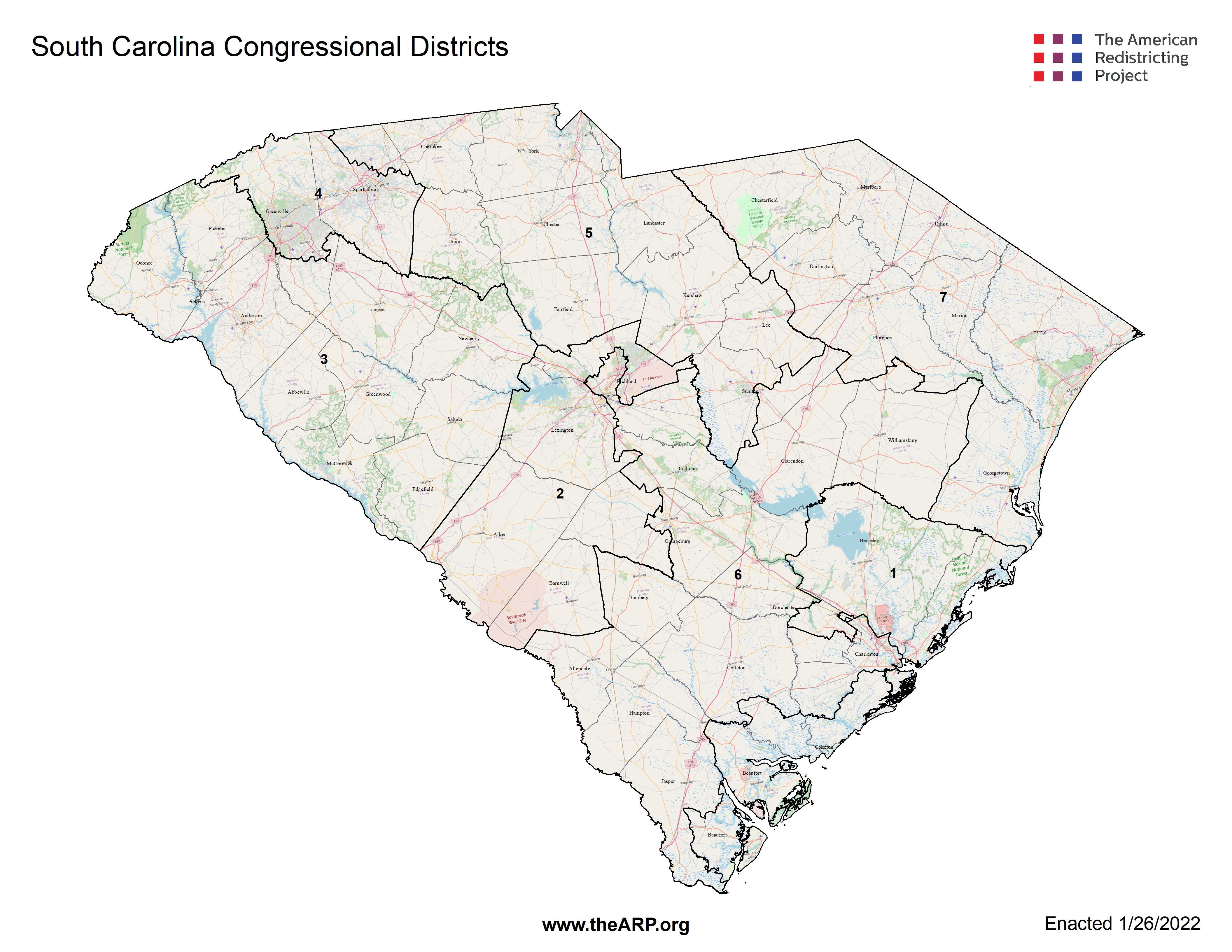
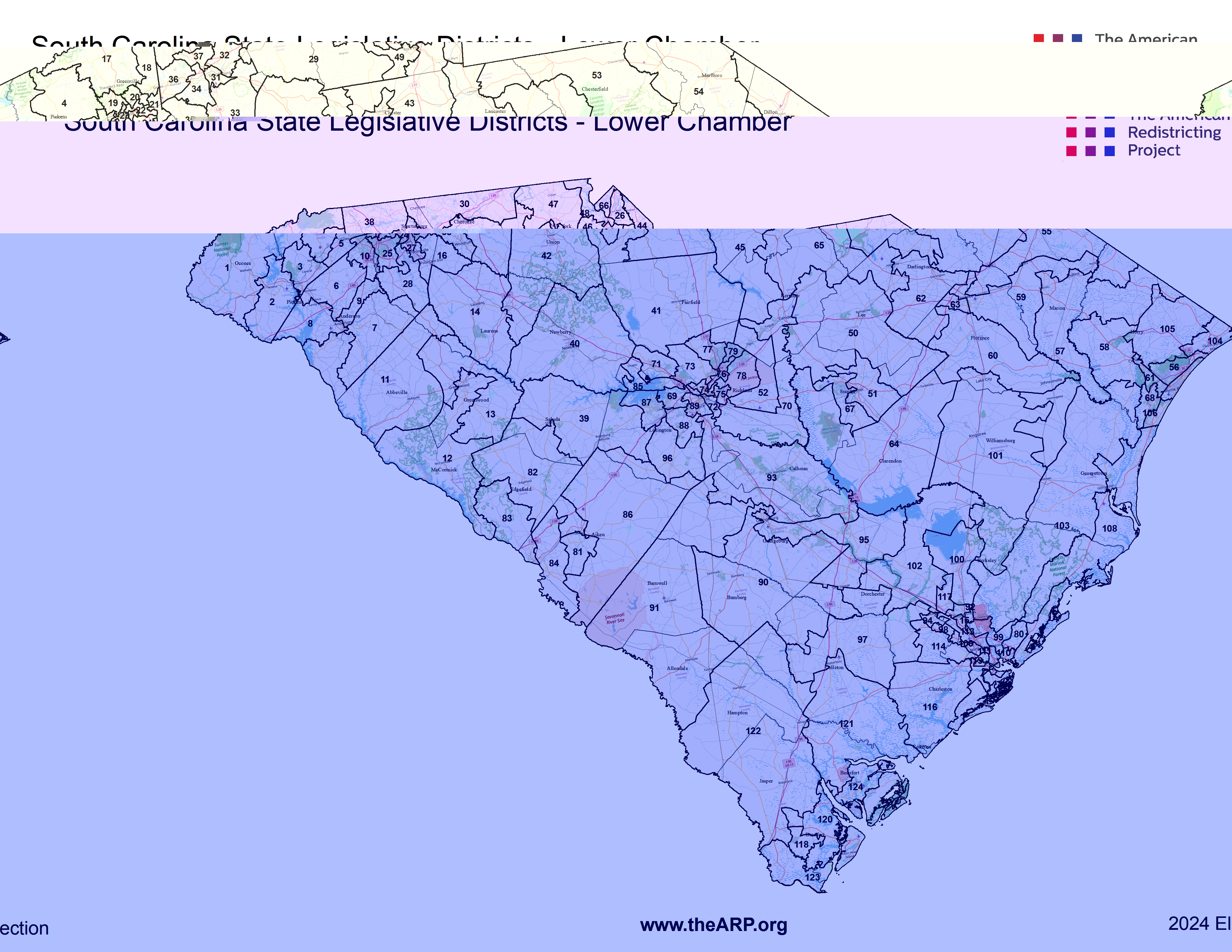
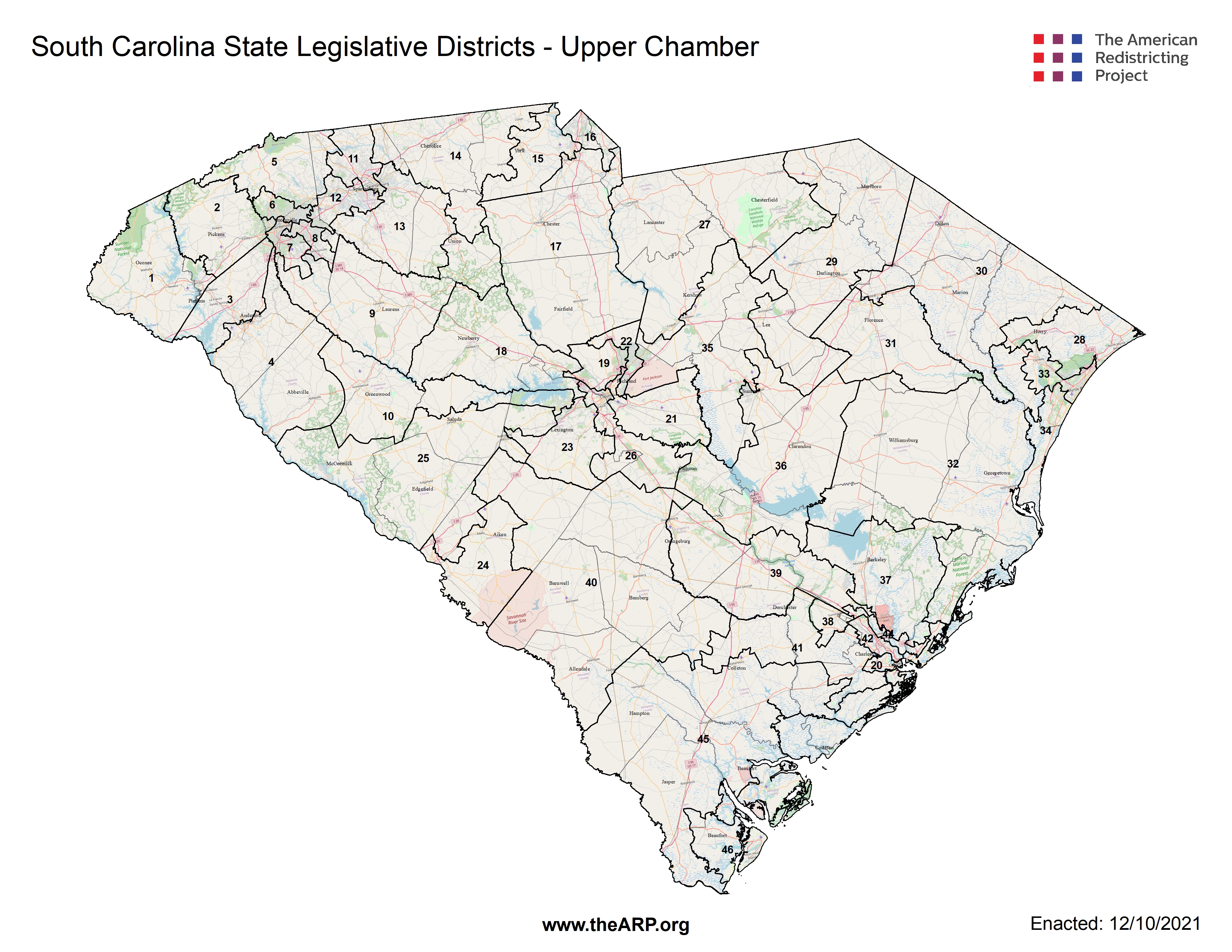
Congressional & Legislative
Primary Authority: Congressional and legislative maps are enacted by the South Carolina General Assembly, subject to the Governor’s veto. The General Assembly can override a veto with a 2/3 vote in each chamber. No party currently has a veto-proof majority in either chamber. [S.C. Const. art. III, §§ 3 – 6]
If a bill is presented to the governor during or after session, the governor has 5 days to sign or veto it; otherwise, it becomes law without signature. Sundays are excluded from these calculations.
Mapping Timeline: Not specified.
Redistricting Criteria: Not specified.
Map Challenges: Not specified.
Ballot Measure & Referendum Processes
Types of Measures: Only the South Carolina General Assembly can refer amendments to the ballot. There is no initiative or referendum process. [S.C. Const. art. XVI]
Previous Redistricting Cycles
2010
- Congressional
- Original Plan – H 3992
- Passed = July 26, 2011 (R-controlled)
- Signed = August 1, 2011
- Preclearance = Granted on October 28, 2011
- Litigation History
- Backus v. South Carolina, 857 F.Supp.2d 553 (D.S.C. 2012): Plaintiffs challenged the Legislature’s enacted congressional and legislative plans as violating various federal constitutional and statutory provisions on several grounds, including racial gerrymandering under the 14th Amendment, vote dilution claim under Section 2 of the Voting Rights Act and the 14th Amendment, and the 15th Amendment. On March 9, 2012, the district court ruled in favor of the defendants on all claims and upheld both sets of plans.
- Aff’d, 133 S.Ct. 156 (2012).
- Legislative
- Original Plans – H 3991 (House); S 815 (Senate)
- Passed = June 22, 2011 (R-controlled)
- Signed = June 28, 2011
- Preclearance = Granted on October 11, 2011 (House); November 14, 2011 (Senate)
- Litigation History
- Backus v. South Carolina, 857 F.Supp.2d 553 (D.S.C. 2012): Plaintiffs challenged the Legislature’s enacted congressional and legislative plans as violating various federal constitutional and statutory provisions on several grounds, including racial gerrymandering under the 14th Amendment, vote dilution claim under Section 2 of the Voting Rights Act and the 14th Amendment, and the 15th Amendment. On March 9, 2012, the district court ruled in favor of the defendants on all claims and upheld both sets of plans.
- Aff’d, 133 S.Ct. 156 (2012).
2000
- Congressional
- Original Plan – HB 3003
- Passed = August 27, 2001 (R-controlled)
- Vetoed = August 30, 2001 (D-controlled)
- Federal Court’s Plan
- Litigation History
- Colleton Cty. Council v. McConnell, 201 F.Supp.2d 618 (D.S.C. 2002): After the Republican Legislature’s congressional and legislative redistricting plans were vetoed by the state’s Democratic Governor, plaintiffs petitioned a federal court to declare the state’s then-existing districts unconstitutionally malapportioned and to order the implementation of interim plans for the impending 2002 elections. On March 20, 2002, the district court ordered the adoption of its interim congressional plan described in Exhibit C to its opinion for use in the 2002 and future elections.
- Legislative
- Original Plans – HB 3003
- Passed = August 27, 2001 (R-controlled)
- Vetoed = August 30, 2001 (D-controlled)
- Federal Court’s Plans
- Legislature’s Revised Plans – S 591
- Passed = May 28, 2003 (R-controlled)
- Signed = June 2, 2003
- Preclearance = Granted
- Litigation History
- Colleton Cty. Council v. McConnell, 201 F.Supp.2d 618 (D.S.C. 2002): After the Republican Legislature’s congressional and legislative redistricting plans were vetoed by the state’s Democratic Governor, plaintiffs petitioned a federal court to declare the state’s then-existing districts unconstitutionally malapportioned and to order the implementation of interim plans for the impending 2002 elections. On March 20, 2002, the district court ordered the adoption of its interim state House and state Senate plans, described in Exhibits A and B to its opinion, for use in the 2002 elections.