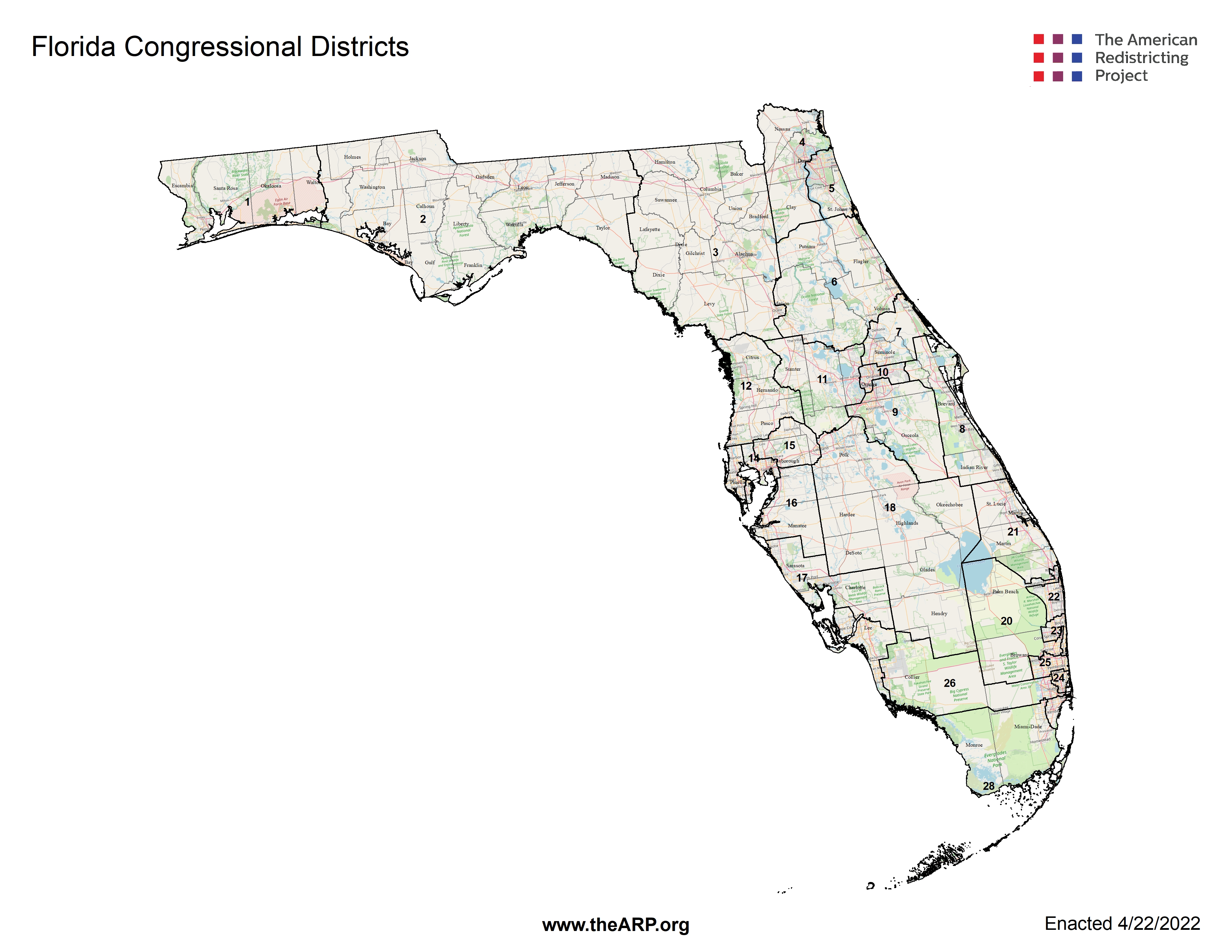
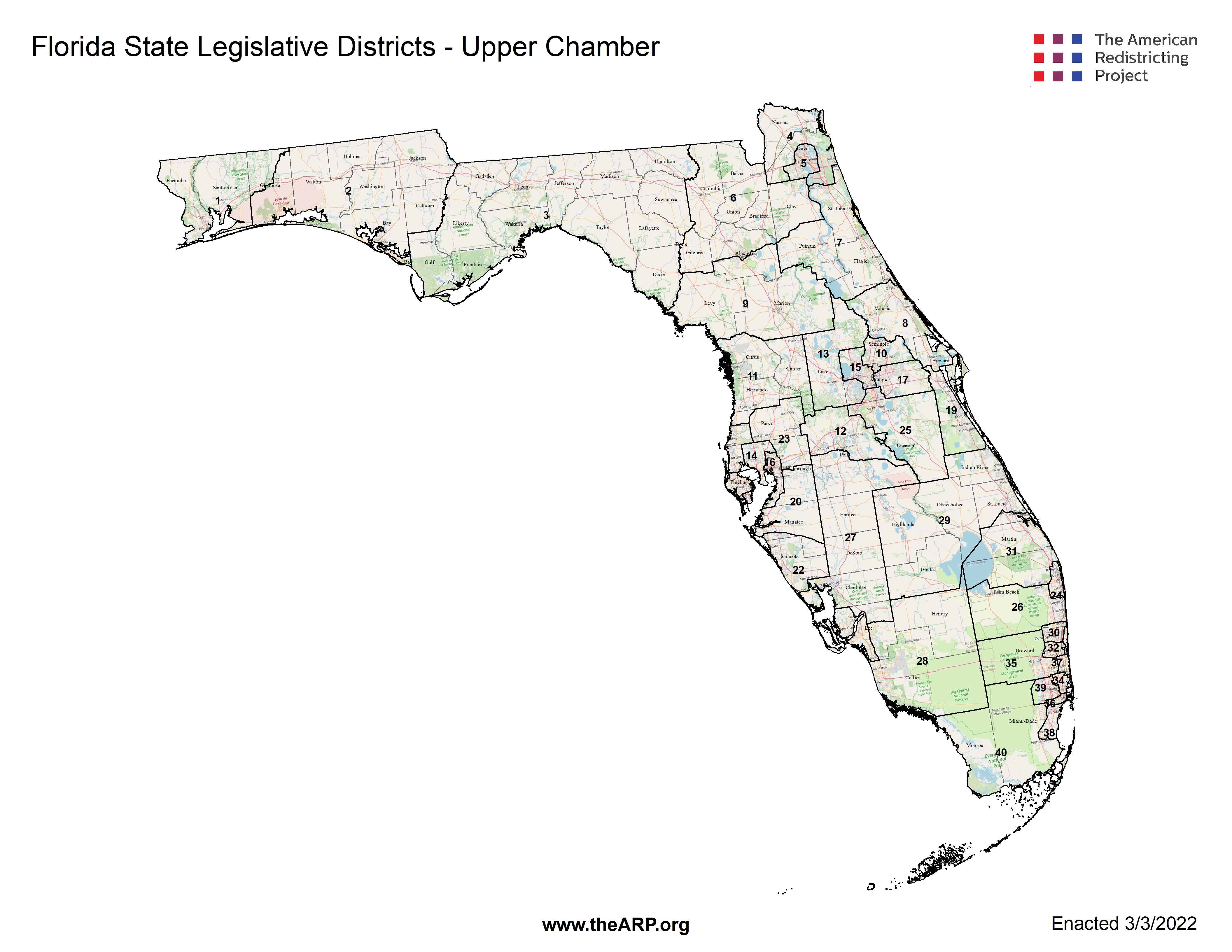
Congressional plans are enacted by the Florida Legislature, subject to the Governor's veto. Legislative plans are enacted by the Florida Legislature as a joint resolution, not subject to the Governor's veto.
Florida’s congressional delegation grew from 27 seats to 28 (a gain of 1 seat) following the 2020 reapportionment.
Primary Authority: The Florida Legislature draws and enacts congressional plans, subject to the Governor's veto. The Legislature can override a veto with a 2/3 vote in each chamber. Republicans currently have a veto proof-majority in both chambers.
If a bill is presented to the Governor during session, the Governor has 7 days to sign or veto it; otherwise, it becomes law without signature. If the legislature adjourns fully or for more than 30 days within the initial 7-day period, the Governor has 15 days from the transmittal to sign or veto; otherwise, it becomes law.
Mapping Timeline: Not specified.
Redistricting Criteria: As nearly equal in population as is practicable; Compact; Contiguous; Utilize existing political and geographical boundaries where feasible.
PROHIBITED: Intentionally favoring/disfavoring a political party or incumbent; Drawing districts with the intent or result of denying or abridging the equal opportunity of racial or language minorities to participate in the political process or diminishing their ability to elect representatives of their choice. [Fla. Const. art. III, § 20]
Map Challenges: Not specified.
Primary Authority: Drawn and enacted by the Florida Legislature as a joint resolution, not subject to the Governor’s veto. [Fla. Const. art. III, § 16]
Backup Authority: If the Legislature fails to enact a final plan by its deadline, the Florida Supreme Court must be petitioned to draw and adopt the plan(s). [Fla. Const. art. III, § 16]
Mapping Timeline: The Legislature must enact final plans by the end of its regular session in the 2nd year following the decennial census. If it fails to do so, the Governor must convene a special apportionment session within 30 days of the regular session’s adjournment to enact plans, lasting no longer than 30 days. Within 15 days after their passage, the plans must be sent to the Florida Supreme Court for review, and the Court must render its decision within 30 days of the petition being filed.
If the special apportionment session ends with no plans being passed, the Attorney General must petition the Florida Supreme Court within 5 days to make the apportionment. The Supreme Court must file its final plans with the custodian of state records within 60 days of the petition being filed. [Fla. Const. art. III, § 16]
Redistricting Criteria: As nearly equal in population as is practicable; Compact; Contiguous; Utilize existing political and geographical boundaries where feasible.
PROHIBITED: Intentionally favoring/disfavoring a political party or incumbent; Drawing districts with the intent or result of denying or abridging the equal opportunity of racial or language minorities to participate in the political process or diminishing their ability to elect representatives of their choice. [Fla. Const. art. III, § 21]
Map Challenges: Within 15 days after final plans are passed, the Attorney General must petition the Florida Supreme Court to determine their validity. The Court must render its judgment within 30 days of the petition being filed. If the plan is rejected, within 5 days of the judgment the Governor must convene an extraordinary apportionment session lasting no longer than 15 days to pass a revised plan in accordance with the Court’s decision. Within 15 days after a revised plan’s passage, the Attorney General must petition the Court to review its validity again. If the revised plan is rejected, the Court must file its own plan with the custodian of state records within 60 days of the petition being filed. [Fla. Const. art. III, § 16]
Types of Measures: Initiatives and referendums are not permitted to amend statutes. Direct initiatives are permitted to amend the state constitution. Legislatively initiated ballot measures may amend the constitution, but not statutes.
Single-Subject Rule: Yes, except for measures that limit the government’s power to tax.
Initiative Subject Restrictions: No.
Signature Requirements: Constitutional amendments require signatures equal to at least 8% of the votes cast in each of at least ½ of the state’s congressional districts, as well as 8% of the total votes cast statewide, in the last preceding general election where presidential electors were chosen. 11,144,855 people voted in the 2020 General Election in Florida, so 891,589 signatures statewide are required for constitutional amendments in addition to the requisite number in each of the relevant districts.
Submission Deadlines: Signatures must be verified by February 1 of the year they are to appear on the ballot.
Circulation Period: 2 years.
Ballot Title and Summary: Ballot title and summary are written by the proponents, subject to approval by the Secretary of State. Expedited reviews for titles and summaries are not permitted.
Other Requirements: A fiscal impact statement is required. 60% of voters must approve constitutional amendments. The legislature can repeal an approved measure through the normal process for amending the state constitution. A 3/5 supermajority vote in each chamber of the Legislature is required to send an amendment to voters. Initiatives are permitted on general election ballots but not on primary, special, or odd-year election ballots.
[Fla. Const. art. XI; Fla. Stat. § 9.100.371; Florida Division of Elections Website]
2010
2000
Current districts for Florida by chamber, shaded by the incumbent’s party.
To view past district shapefiles, see our Map Archive Page.
Formerly Hodges v. Passidomo.
Formerly Common Cause Florida v. Lee.