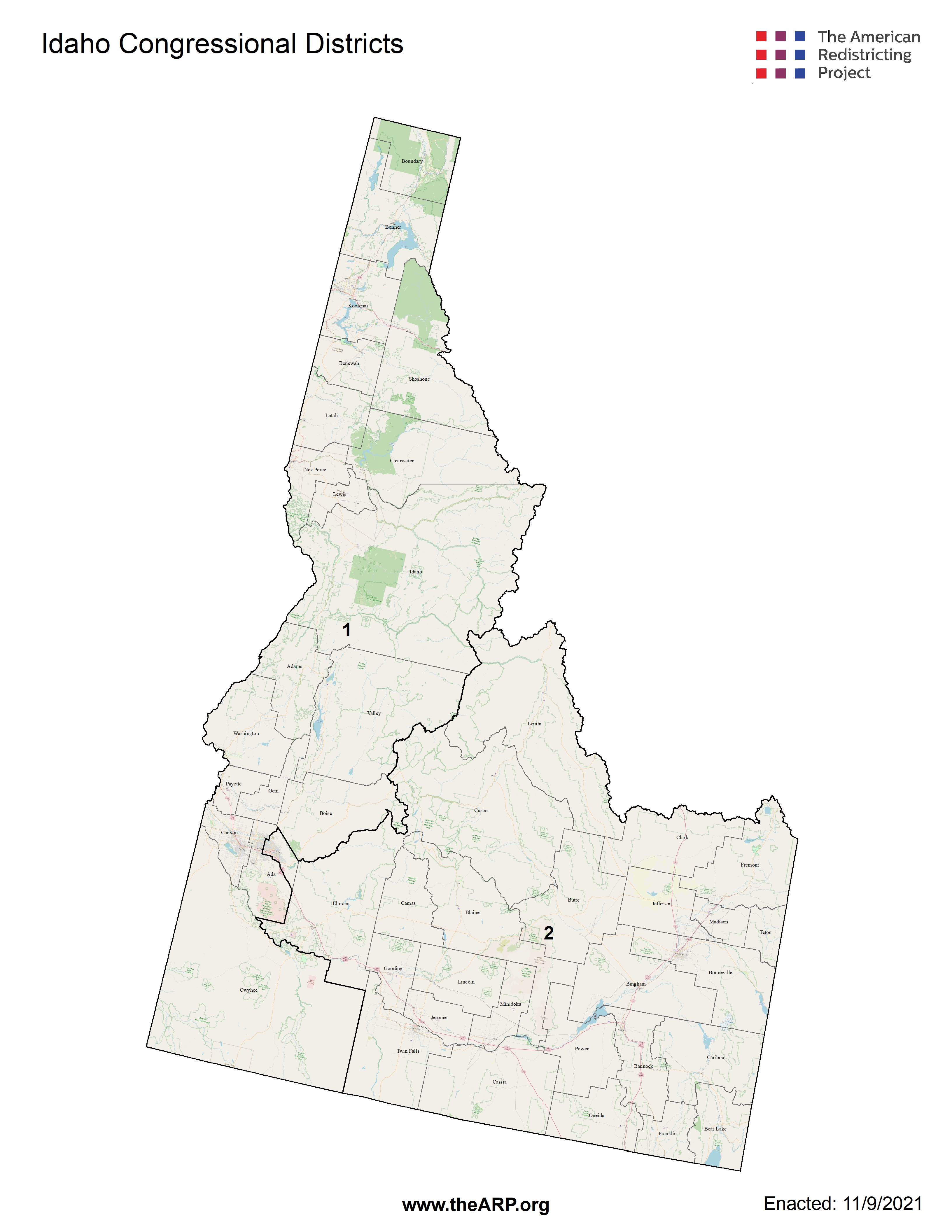
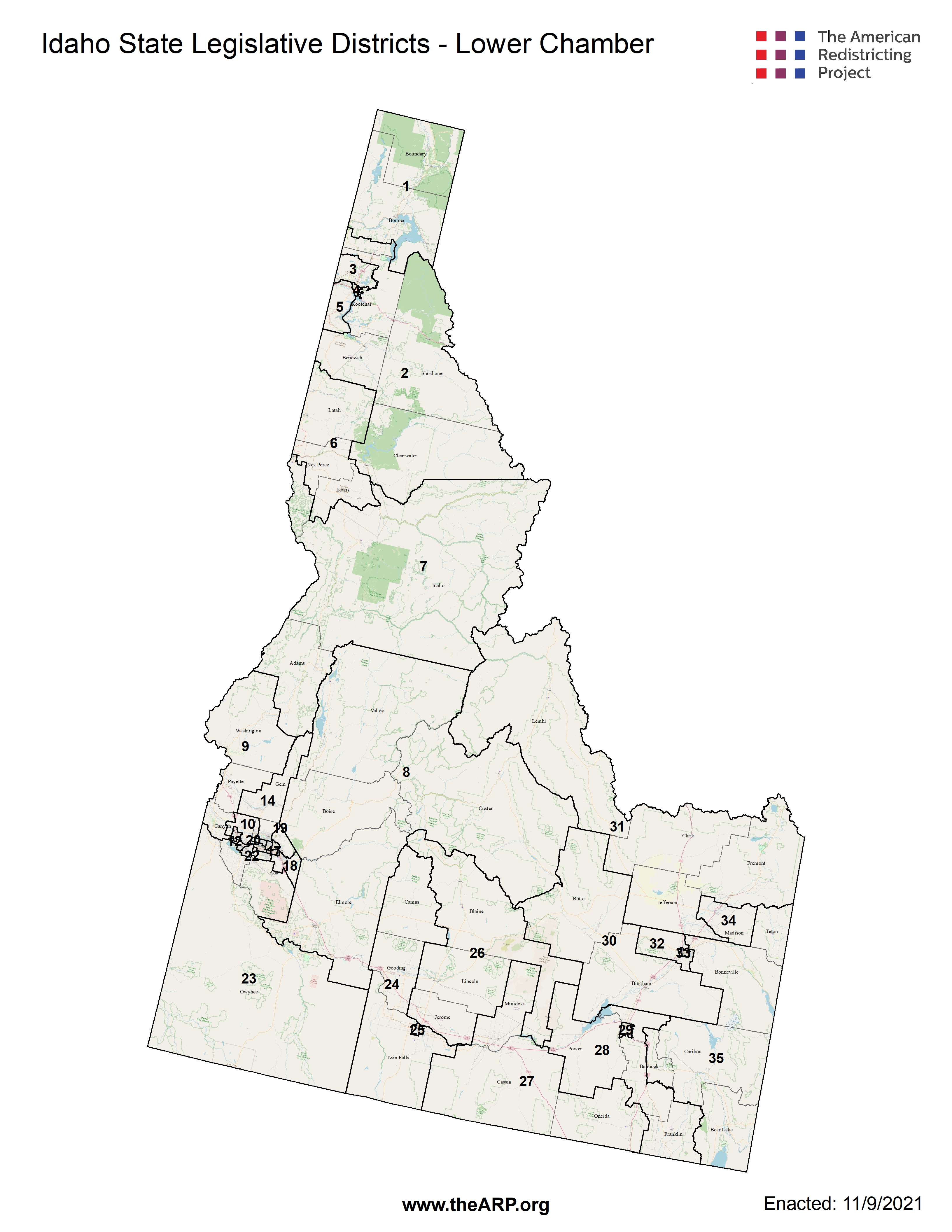
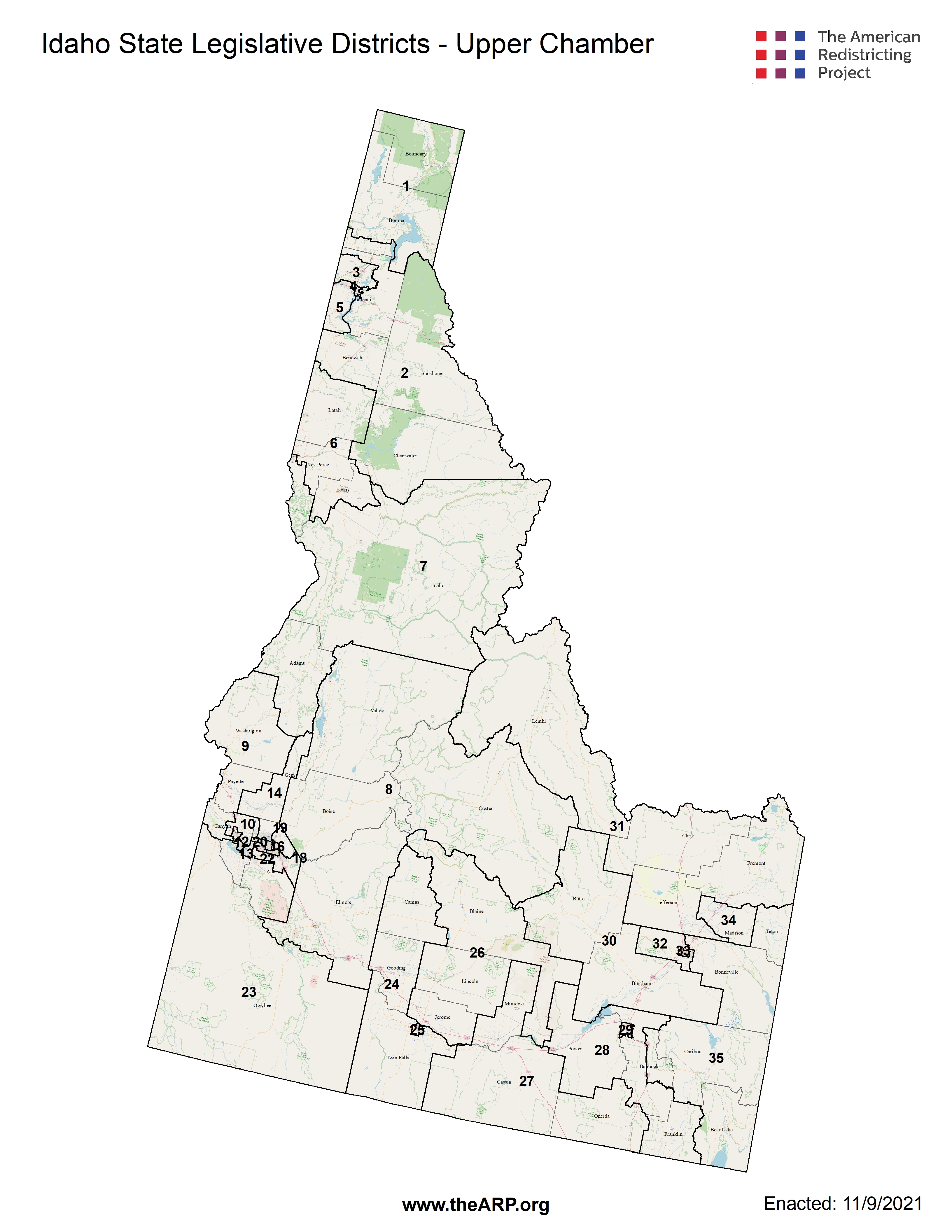
Congressional and legislative plans are drawn and adopted by the Idaho Citizen Commission for Reapportionment, a 6-member politically appointed body.
Idaho’s congressional delegation remained at 2 seats following the 2020 reapportionment.
Primary Authority: Congressional and legislative plans are drawn and adopted by Idaho’s Citizen Commission for Reapportionment, a 6-member politically appointed body.
Mapping Timeline: Within 90 days of the Commission’s organization or census data becoming available, whichever is later, the Commission must file proposed legislative and congressional redistricting plans along with their final report with the Secretary of State. There is no specific deadline for final plans. Plans take effect after they are filed. [Idaho Const. art. III, § 2; Idaho Code §§ 72-1505, 72-1508]
Redistricting Criteria:
Map Challenges: Filed in the Idaho Supreme Court. Before October 1 in years ending in 1, any registered voter or municipality can file a petition to challenge an existing legislative redistricting plan based on new federal census data OR appeal a congressional or legislative plan adopted by the Commission. [Idaho Code §§ 72-1509, 72-1510]
Types of Measures: Direct initiatives and referendums are permitted to amend statutes. Initiatives are not permitted to amend the state constitution. Legislatively initiated ballot measures may amend both statutes and the constitution.
Single-Subject Rule: No.
Initiative Subject Restrictions: No.
Signature Requirements: 20 Preliminary signatures are required for all measures. Statutory initiatives and veto referendums require 6% of the qualified electors at the time of the last general election in each of at least 18 of the state’s legislative districts, with the total number of signatures equal to at least 6% of the qualified electors statewide at the time of the last general election. At the 2022 general election in Idaho, there were 1,048,263 qualified electors, so 62,896 signatures are required for initiatives and referendums. Legislative district information can be found here.
Submission Deadlines: Initiative petitions must be submitted to the appropriate county clerk by May 1 of the year the petition is to be on the ballot. They must also be submitted to the Secretary of State at least 4 months prior to the election in which it will appear on the ballot (July 5, 2024). Referendums must be submitted no more than 60 days after the end of the legislative session.
Circulation Period: The circulation period for initiative petitions is 18 months. No signatures may be collected after the end of April in the year the petition is to appear on the ballot.
Ballot Title and Summary: The ballot title and summary are written by the Attorney General and Secretary of State. Expedited reviews are permitted.
Other Requirements: A fiscal impact statement is not required. Circulators are required to be at least 18 years old and a resident of the state. There are no supermajority requirements. Initiatives are permitted on general election ballots but not on primary, special, or odd-year election ballots.
[Idaho Const. art. III, § 1; Idaho Code §§ 34-1801 — 34-1823; Idaho Secretary of State Website]
2020
2010
2000
Current districts for Idaho by chamber, shaded by the incumbent’s party.
To view past district shapefiles, see our Map Archive Page.
No active cases on record for Idaho.