
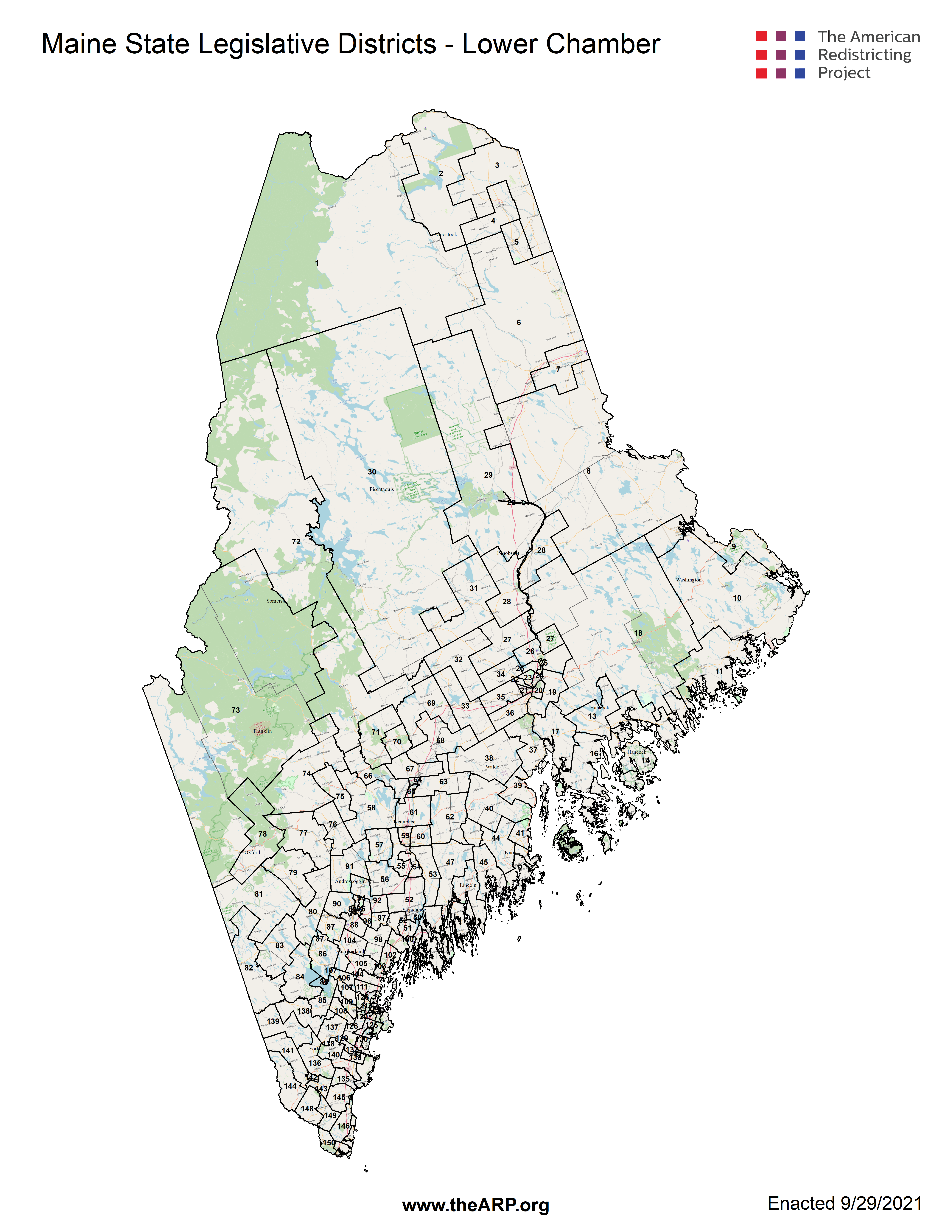
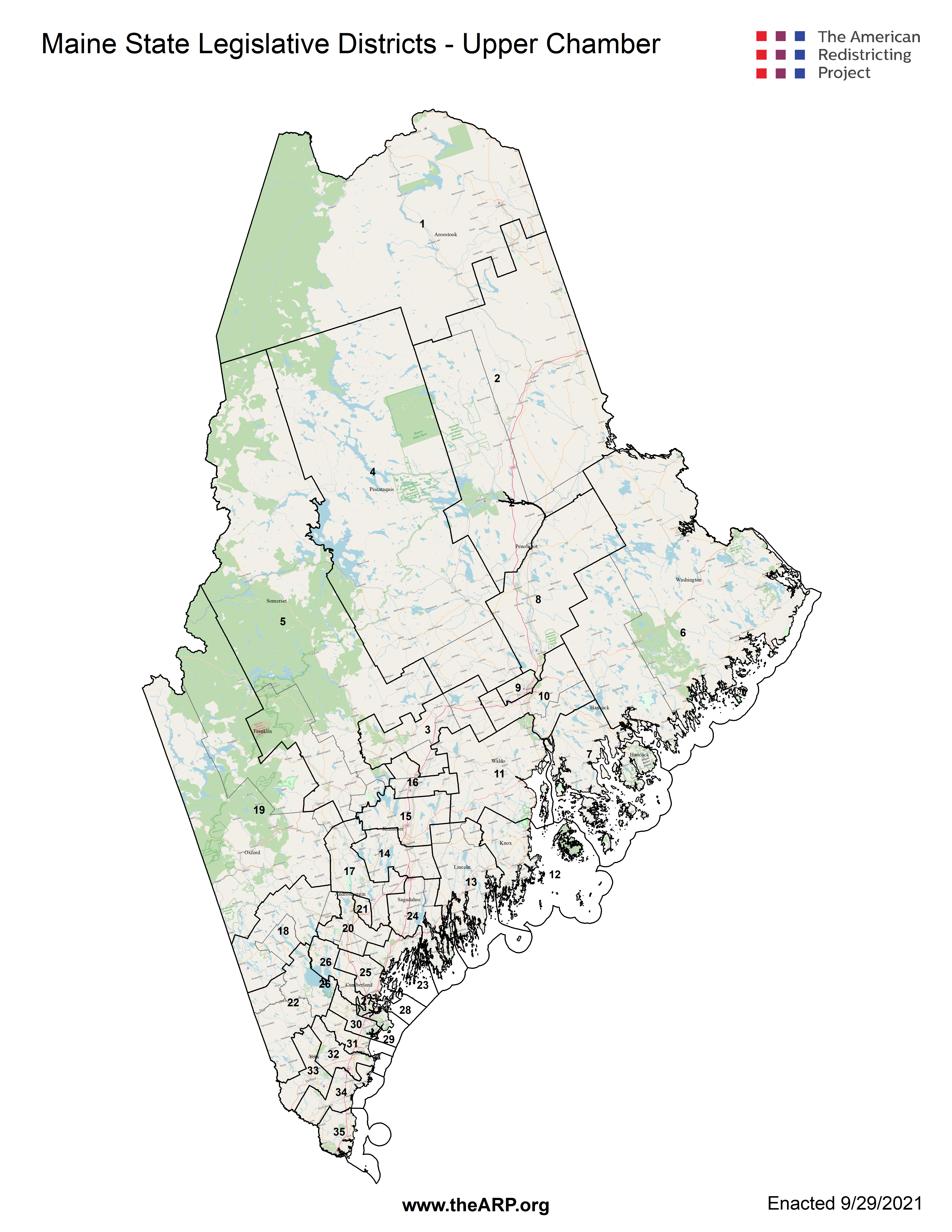
Congressional and legislative maps are enacted by the Maine State Legislature, subject to the Governor’s veto, after receiving proposals from the Legislative Apportionment Commission, a 15-member advisory body.
Maine’s congressional delegation remained at 2 seats following the 2020 reapportionment.
Primary Authority: The Maine State Legislature enacts congressional and legislative plans after receiving proposals from the advisory Legislative Apportionment Commission. The Legislature can enact or amend the Commission’s proposals, or enact their own plans, with a 2/3 vote in each chamber, subject to the Governor’s veto. The Legislature can override a veto with a 2/3 vote in each chamber. No party currently has a veto-proof majority in either chamber. [Me. Const. art. IV, pt. 1, § 3; pt. 2, § 2; Me. Stat. tit. 21-A, § 1206]
If a bill is presented to the Governor during session, the Governor has 10 days to sign or veto it; otherwise, it becomes law without signature. If the session adjourns before the 10-day period elapses and that Legislature is not scheduled to meet again, the bill is pocket vetoed. If that Legislature is set to meet again, the Governor must veto and return the bill within 3 days of it reconvening; otherwise, it becomes law without signature.
Advisory Commission: The Legislative Apportionment Commission, a 15-member body, submits proposed congressional and legislative plans to the Legislature which can choose to enact them or plans of their own.
Mapping Timeline: The Commission must submit its proposed plans to the Legislature by June 1 of years ending in 1. The Legislature must enact final plans by June 11 of that year.
If the Legislature fails to enact plan(s) by its deadline, the Maine Supreme Court must adopt plan(s) within 60 days after that missed deadline. The Court must consider plans and briefs filed by the public in the first 30 days after assuming control over the process. [Me. Const. art. IV, pt. 1, § 2; pt. 2, § 2; Me. Stat. tit. 21-A, § 1206]
Redistricting Criteria:
Map Challenges: Filed in the Maine Supreme Court. If the plan is struck down, the Court draws and adopts the remedial plan. [Me. Stat. tit. 21-A, § 1206]
Types of Measures: Indirect initiatives and referendums are permitted to amend statutes. Initiatives are not permitted to amend the state constitution. Legislatively initiated ballot measures may amend both statutes and the state constitution.
Single-Subject Rule: No.
Initiative Subject Restrictions: No.
Signature Requirements: 5 preliminary signatures are required. Statutory initiatives and referendums require 10% of all votes cast for all candidates for Governor in the last gubernatorial election. 676,819 people voted for a gubernatorial candidate in the 2022 general election in Maine, so 67,682 signatures are required.
Submission Deadlines: Initiative petitions must be submitted on or before the 50th day after the convening of the Legislature in their first regular session or on or before the 25th day after the convening of their second regular session. Referendums must be submitted within 90 days after the legislative session’s adjournment.
Circulation Period: The circulation period for initiative petitions is 18 months. A signature is not valid if it is dated more than 1 year prior to the date the petition was filed with the Secretary of State.
Ballot Title and Summary: The ballot question is written by the Secretary of State. Expedited reviews are not permitted.
Other Requirements: A fiscal impact statement is required. Circulators are required to be registered voters. There are no supermajority requirements. Initiatives are permitted on general and odd-year election ballots, but not on primary and special election ballots.
[Me. Const. art. IV, pt. 3; art. X, § 4; Me. Stat. tit. 1, §§ 351-354; tit. 21-A, §§ 901-907; Maine Bureau of Corporations, Elections & Commissions Website]
2020
2010
2000
Current districts for Maine by chamber, shaded by the incumbent’s party.
To view past district shapefiles, see our Map Archive Page.
No active cases on record for Maine.