Congressional
Primary Authority: Congressional plans are drawn and adopted by the New Jersey Redistricting Commission, a 13-member body of political appointees.
- Members: The President and minority leader of the New Jersey Senate and the Speaker and minority leader of the New Jersey General Assembly each appoints 2 members. The chairmen of the political party committees whose gubernatorial candidates received the most and second most votes at the most recent election each appoint 2 members. The initial 12 members then select a 13th member by majority vote, who serves as chair. If they fail to agree on the final member by their deadline, they submit the names of the two persons who received the greatest number of votes to the New Jersey Supreme Court who selects the 13th member by majority vote. [N.J. Const. art. II, § II, ¶¶ 1, 2]
- Timing: The initial 12 commissioners must be appointed by June 15 and certified to the Secretary of State by July 1 of years ending in 1. The initial 12 commissioners must select the 13th member by July 15 and certified to the Secretary of State by July 20 of years ending in 1. If they fail, they must submit the two names to the state Supreme Court by July 20 and the Court must appoint the final member by August 10 and certify them to the Secretary of State by August 15 of years ending in 1. The Commission must meet and organize no later than the Wednesday after the first Monday in September of years ending in 1. [N.J. Const. art. II, § II, ¶¶ 1, 2]
- Eligibility: Commission members must be appointed with consideration of the geographic, ethnic, and racial diversity of the state, and none may be a member or employee of Congress. The 13th member must have been a resident of the state for the preceding 5 years and must not have held public or party office in the state during that time. If the state Supreme Court selects the 13th member, they must select the one more qualified by educational and occupational experience, by prior public service in government or otherwise, and by demonstrated ability to represent the best interest of the people of New Jersey. [N.J. Const. art. II, § II, ¶ 1]
- Voting: At least 7 commissioners are required for a quorum, and all official actions, including the adoption of final plans, require affirmative votes from at least 7 commissioners. If the commission deadlocks on a final plan, the two plans receiving the greatest number of votes but no less than 5 are submitted to the state Supreme Court. [N.J. Const. art. II, § II, ¶ 1, 2]
- Public Input & Transparency: The Commission must hold at least 3 public hearings in different parts of the state and shall review plans submitted by members of the public, subject to the constraints of time and convenience. Votes to adopt a final plan must be done in an open public meeting for which there is at least 24 hours public notice, and votes must be recorded. All other meetings besides the mandatory 3 public hearings and one in which a final plan will be voted on may be closed to the public. [N.J. Const. art. II, § II, ¶¶ 3, 4, 5]
Mapping Timeline: After holding the required public hearings, the Commission must adopt and certify its final congressional plan to the Secretary of State either on or before the 3rd Tuesday of years ending in 2 or within 3 months of receiving the state’s congressional reapportionment figure from the decennial census, whichever is later. If the commission deadlocks on a final plan, the two plans receiving the greatest number of votes but no less than 5 are submitted to the state Supreme Court. The state Supreme Court then selects whichever plan best conforms to constitutional and statutory requirements, but no deadline is specified. [N.J. Const. art. II, § II, ¶¶ 3, 4]
Redistricting Criteria: None.
Map Challenges: Filed in the New Jersey Supreme Court. If a plan is declared unlawful, the Commission must reform and adopt a new plan within the time period specified by the court or within a shorter period of time as may be necessary to ensure the new plan is effective for the next congressional primary and general election. [N.J. Const. art. II, § II, ¶¶ 7, 9]
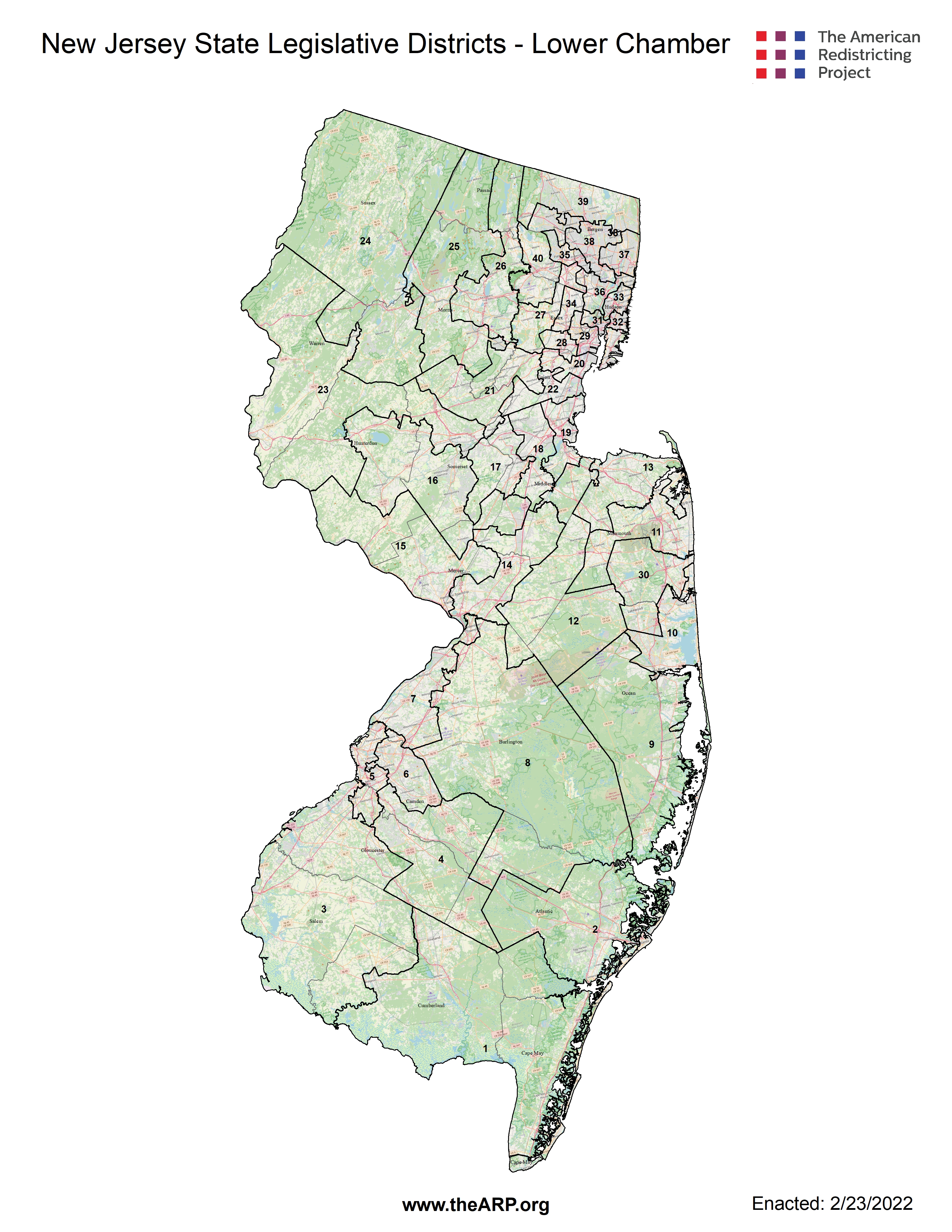
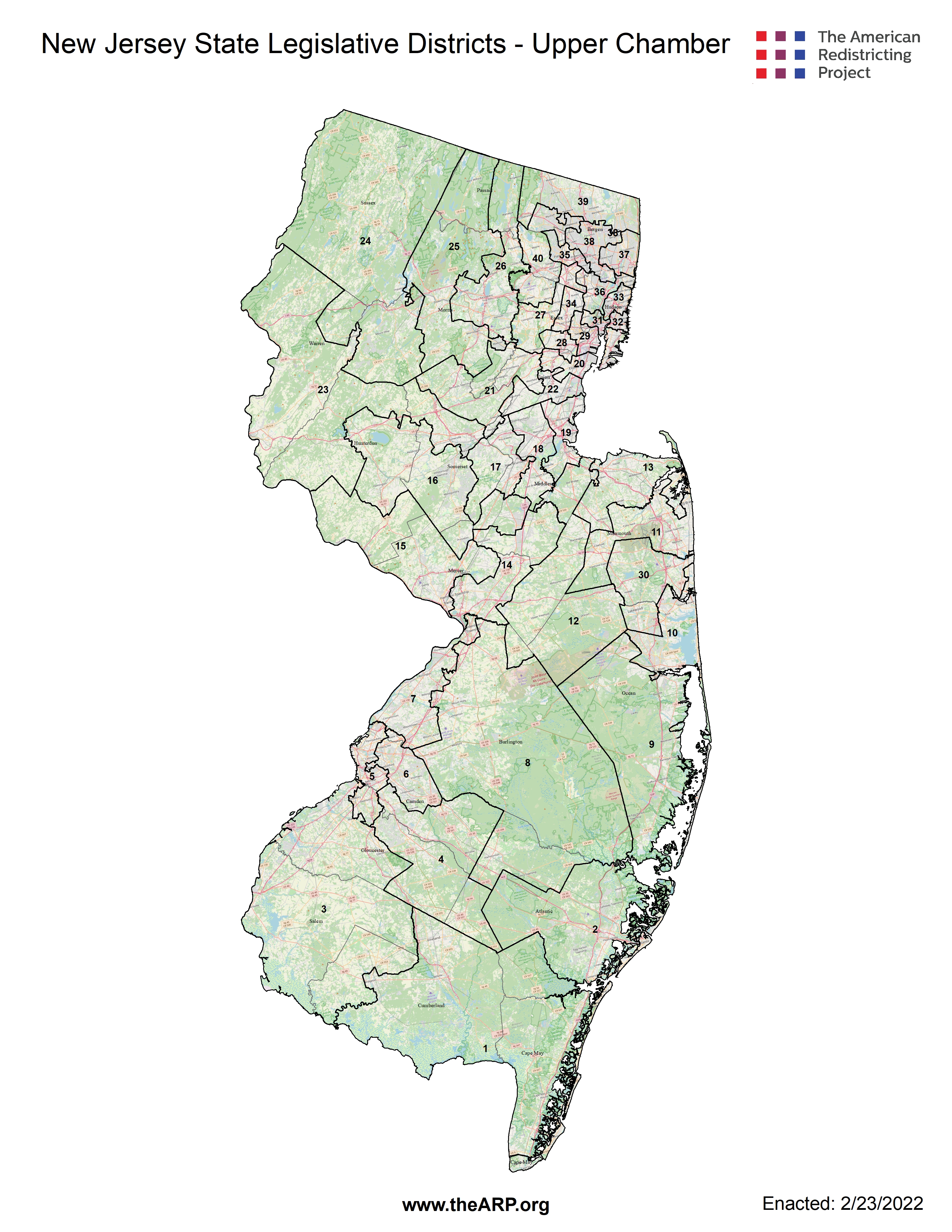
Legislative
Primary Authority: Legislative plans are drawn and adopted by New Jersey’s Apportionment Commission, a 10-member, politically appointed body. An 11th member is appointed if the initial 10 cannot reach an agreement on final plans.
- Members: The chairmen of the state political parties whose gubernatorial candidates received the most and second most votes in the last election each appoint 5 members. The chairmen must consider representation for the various geographic areas of the state in making their selections. If the 10 commissioners fail to agree on a final plan by their deadline, the Chief Justice of the New Jersey Supreme Court appoints an 11th member to the Commission. [N.J. Const. art. IV, § III, ¶¶ 1, 2]
- Timing: The state party committee chairmen must select their appointees by November 15 and certify them to the Secretary of State by December 1 of the decennial census year. If the Commission fails to adopt final plans by its deadline, the state Supreme Court must then appoint the 11th member but no deadline to do so is specified. If decennial census data is delivered to the state after February 15 of the year ending in 1, the Commission must begin its work upon receipt of the data and the 11th member must be appointed by the Chief Justice within 1 month of the date on which data was received. [N.J. Const. art. IV, § III, ¶¶ 1, 2, 4]
- Eligibility: No restrictions specified.
- Voting: Official actions, including the adoption of final plans, require a majority vote. [N.J. Const. art. IV, § III, ¶¶ 1, 2]
- Public Input & Transparency: No requirements.
Mapping Timeline: The Commission must adopt and certify final legislative plans to the Secretary of State either within 1 month of receiving decennial census data or by February 1 of the year after the decennial census year, whichever is later. If the 10-member Commission fails to meet its deadline, the 11th member is appointed by the Chief Justice of the state Supreme Court and the Commission must adopt and certify final legislative plans to the Secretary of State within 1 month of the 11th member’s appointment.
If decennial census data is delivered after February 15 of years ending in 1, the Commission must adopt and certify final legislative plans to the Secretary of State after the November general election of that year but no later than March 1 of years ending in 2. [N.J. Const. art. IV, § III, ¶¶ 1, 2, 4]
Redistricting Criteria:
- State Senate: Contiguous; Preserve whole counties wherever practicable; As nearly equal in population as may be. [N.J. Const. art. IV, § II, ¶ 1]
- State House: Compact; Contiguous; As nearly equal in population as possible; Avoid divisions of counties and municipalities unless necessary to comply with other requirements. [N.J. Const. art. IV, § II, ¶ 3]
Map Challenges: Not specified.