The Ohio General Assembly has the first opportunity to pass a congressional plan, subject to the Governor’s veto. If they fail, authority passes to the Ohio Redistricting Commission, a 7-member body of elected officials and political appointees. If the Commission fails, authority passes back to the General Assembly. The Commission is solely responsible for adopting legislative plans. An advisory task force aids both processes.
Ohio’s congressional delegation shrunk from 16 seats to 15 (a loss of 1 seat) following the 2020 reapportionment.
Primary Authority: Congressional plans are either enacted by the Ohio General Assembly, subject to the Governor’s veto, or adopted by the Ohio Redistricting Commission, a 7-member body of elected officials and political appointees. If a bill is presented to the governor during or after session, the governor has 10 days to sign or veto it; otherwise, it becomes law without signature. Sundays are excluded from these calculations.
Congressional redistricting authority, applicable criteria, and the length of time plans are effective for vary depending on when plans are passed, which authority passes them, and the level of bipartisan support they receive.
The Ohio General Assembly has the first opportunity to enact a congressional plan. At least 3/5 of the members in each chamber must vote in favor of the plan, including at least ½ of the members from the two largest political parties in each chamber. If successful, this plan remains effective until the next year ending in 1. [Ohio Const. art. XIX, § 1(A)]
If the General Assembly fails to pass a plan by this first deadline, the Ohio Redistricting Commission is formed to adopt a plan. At least 4 Commissioners must vote in favor of the plan, including at least 2 Commissioners from each of the two largest political parties in the General Assembly. If successful, this plan remains effective until the next year ending in 1. [Ohio Const. art. XIX, § 1(B)]
If the Commission fails to adopt a plan by its deadline, authority passes back to the General Assembly which can enact either a 4-year plan or a 10-year plan. If the plan is passed by at least 3/5 of the members in each chamber, including at least 1/3 of the members from each of the two largest political parties therein, the plan remains effective until the next year ending in 1 (10-year plan). If the plan is passed by a simple majority of members, it must comply with additional redistricting criteria (listed below) and remains effective for two successive general elections (4-year plan). [Ohio Const. art. XIX, § 1(C)]
If a four-year plan is passed, then the General Assembly must pass a new plan in the year following that plan’s expiration. This plan must be passed by at least 3/5 of the members in each chamber, including at least ½ of the members from each of the two largest political parties therein. If successful, this plan remains effective until the next year ending in 1. [Ohio Const. art. XIX, § 1(D)]
If the General Assembly fails to enact a new plan by its deadline following the expiration of a 4-year plan, the Ohio Redistricting Commission is reconvened to adopt a plan. At least 4 Commissioners must vote in favor of the plan, including at least 2 Commissioners from each of the two largest political parties in the General Assembly. If successful, this plan remains effective until the next year ending in 1. [Ohio Const. art. XIX, § 1(E)]
If the Commission fails to adopt a new plan by its deadline, authority passes back to the General Assembly with two different vote thresholds possible for enacting a plan. If it passes a plan by a 3/5 vote in each chamber, including at least 1/3 of the members of each of the two largest political parties therein, the plan remains effective until the next year ending in 1. If it passes a plan by a simple majority in each chamber, the plan remains effective until the next year ending in 1 but it must comply with the additional redistricting criteria (listed below). [Ohio Const. art. XIX, § 1(F)]
Backup Authority: The Ohio Redistricting Commission assumes congressional redistricting authority at various points in the process if the General Assembly fails to enact a plan by its relevant deadline. The Commission is a 7-member body of elected officials and political appointees.
Advisory Authority: The Legislative Task Force on Redistricting, Reapportionment, and Demographic Research, a 6-member, politically appointed body, aids the General Assembly and Ohio Redistricting Commission in creating plans. [Ohio Rev. Code Ann. § 103.51]
Mapping Timeline: Prior to passing or adopting a final plan at any of the points specified below, the General Assembly or Commission must hold the required public hearings on a proposed plan.
Redistricting Criteria: Ohio has two sets of congressional redistricting criteria. One set applies to all congressional plans regardless of who passed them. If the General Assembly passes a plan by a simple majority, the plan must comply with the second set of criteria in addition to the first set of generally applicable criteria.
Public Input & Transparency: At all points throughout the process, a joint committee of the General Assembly is required to hold at least 2 public hearings on a proposed congressional plan prior to passing a final plan. The General Assembly must facilitate and allow for the submission of proposed plans from members of the public. Any final plan sent to the Governor must include both a legal description of the district boundaries and all underlying data necessary to create a congressional plan. If it was passed by the General Assembly by a simple majority, it must also include an explanation of its compliance with the additional redistricting criteria. [Ohio Const. art. XIX, §§ 1(C)(3)(d), (F)(3)(d), (G) – (I)]
Map Challenges: Filed in the Ohio Supreme Court. If the Court strikes down a plan or portion thereof, the General Assembly must pass a remedial plan changing only those areas identified as defective no later than the 30th day after the date of the order, if not appealable, or the 30th day after the last day on which an appeal could have been filed. If the General Assembly fails to pass a remedial plan by its deadline, the Ohio Redistricting Commission must reconvene and adopt a remedial plan, again changing only the parts identified as defective, no later than the 30th day after the General Assembly’s missed deadline. The Ohio Supreme Court does not retain authority to review a remedial plan; instead, a new challenge must be filed. [Ohio Const. art. XIX, § 3]
Primary Authority: The Ohio Redistricting Commission, a 7-member body of elected officials and political appointees, draws and adopts legislative plans. In its first attempt, if successful, the Commission adopts a plan that is effective for ten years. If it fails to adopt a plan by its first deadline, it has another opportunity to adopt a plan that will be effective for either ten years or two successive general elections (four-year plan), depending on the level of Commissioner support the plan was adopted with. If it passes a four-year plan, after that plan expires the Commission reconvenes and must adopt a new plan that will be effective until the next year ending in 1, even if it passes by simple majority.
Advisory Authority: The Legislative Task Force on Redistricting, Reapportionment, and Demographic Research described above aids the Ohio Redistricting Commission in creating plans. [Ohio Rev. Code Ann. § 103.51]
Mapping Timeline:
Redistricting Criteria:
Map Challenges: Filed in the Ohio Supreme Court. The Court is prohibited from ordering the Commission to implement any plan that hasn’t been approved by the Commission, nor can it direct the Commission to adopt any particular plan or draw any particular district. If the Court finds that a plan has one or more isolated violations of the state’s constitutional requirements, it must order the Commission to amend the plan to correct such violations. If the Court finds it necessary to amend 6 or more House districts, or 2 or more Senate districts, or both, the Court must declare the entire plan invalid and order the Commission to adopt a new plan. Similarly, when reviewing a plan adopted by a simple majority of Commissioners or one adopted to replace a four-year plan, the Court must order a new plan be drawn and adopted if both of the following are true: The plan significantly violates requirements so as to materially affect the plan’s ability to contain districts whose voters favor political parties in an overall proportion corresponding closely to the statewide party preferences of Ohio voters, and the statewide proportion of districts in the plan whose voters favor each party do not correspond closely to the statewide preferences of Ohio voters. [Ohio Const. art. XI, § 9]
Types of Measures: Direct and indirect initiatives and referendums are permitted to amend statutes. Direct initiatives are permitted to amend the state constitution. Legislatively initiated ballot measures can amend both statutes and the state constitution.
Single-Subject Rule: Yes.
Initiative Subject Restrictions: Initiatives cannot contain measures involving property taxes, non-legislative issues, or the establishment of monopolies.
Signature Requirements: 1000 preliminary signatures are required for all petitions. Constitutional amendments require signatures equal to 10% of all votes cast for all candidates for Governor in the previous gubernatorial election, 6% for veto referendums, and 3% for statutory initiatives (3% to send to the General Assembly and, if they fail to enact it, another 3% to place the measure directly on the ballot). Signatures must be collected from at least 44 of Ohio’s 88 counties. For constitutional amendments, the signatures from each of those counties must be equal to at least 5% of the votes cast for a gubernatorial candidate in the previous general election, 3% for veto referendums, 1.5% for an initiative to go to the General Assembly and another 1.5% to place that initiative directly on the ballot. 4,134,877 people voted for a gubernatorial candidate in the 2022 general election in Ohio, so 413,488 are required for constitutional amendments, 248,093 for veto referendums, and 124,047 for statutory initiatives.
Submission Deadlines: Constitutional amendments must be submitted 125 days prior to the election in which it is to appear on the ballot (July 3, 2024). To submit a statutory initiative to the General Assembly, the petition must be submitted no less than 10 days prior to the convening of the General Assembly. If the General Assembly fails to enact the measure within 4 months, the supplemental signatures must be submitted within 90 days of the General Assembly’s rejection of, or failure to act on, the measure, and the petition must generally be filed no less than 125 days prior to the election in which it is to appear on the ballot. If a referendum petition is filed less than 125 days before the next general election, the referendum will be placed on the next general election ballot that occurs over a year later. For all types of petitions, if signatures are deemed insufficient or invalid, proponents are given an additional 10 days to collect and file additional signatures.
Circulation Period: Not specified.
Ballot Title and Summary: The ballot title and summary are written by the proponents, subject to approval by the Secretary of State. Expedited reviews for titles and summaries are not permitted.
Other Requirements: A fiscal impact statement is required. Circulators must be at least 18 years old and have a permanent residence in the state. There are no supermajority requirements. The General Assembly can amend or repeal an approved statute through a majority vote. Constitutional amendments can be altered by the General Assembly with a 3/5 vote in both chambers as well as a majority vote of the people. Initiatives are permitted on general and off-year election ballots, but not on primary or special election ballots.
[Ohio Const. art. II, §§ 1 – 1g; art. XVI; Ohio Rev. Code Ann. §§ 3519.01 – 3519.22; Ohio Attorney General Website]
2010
2000
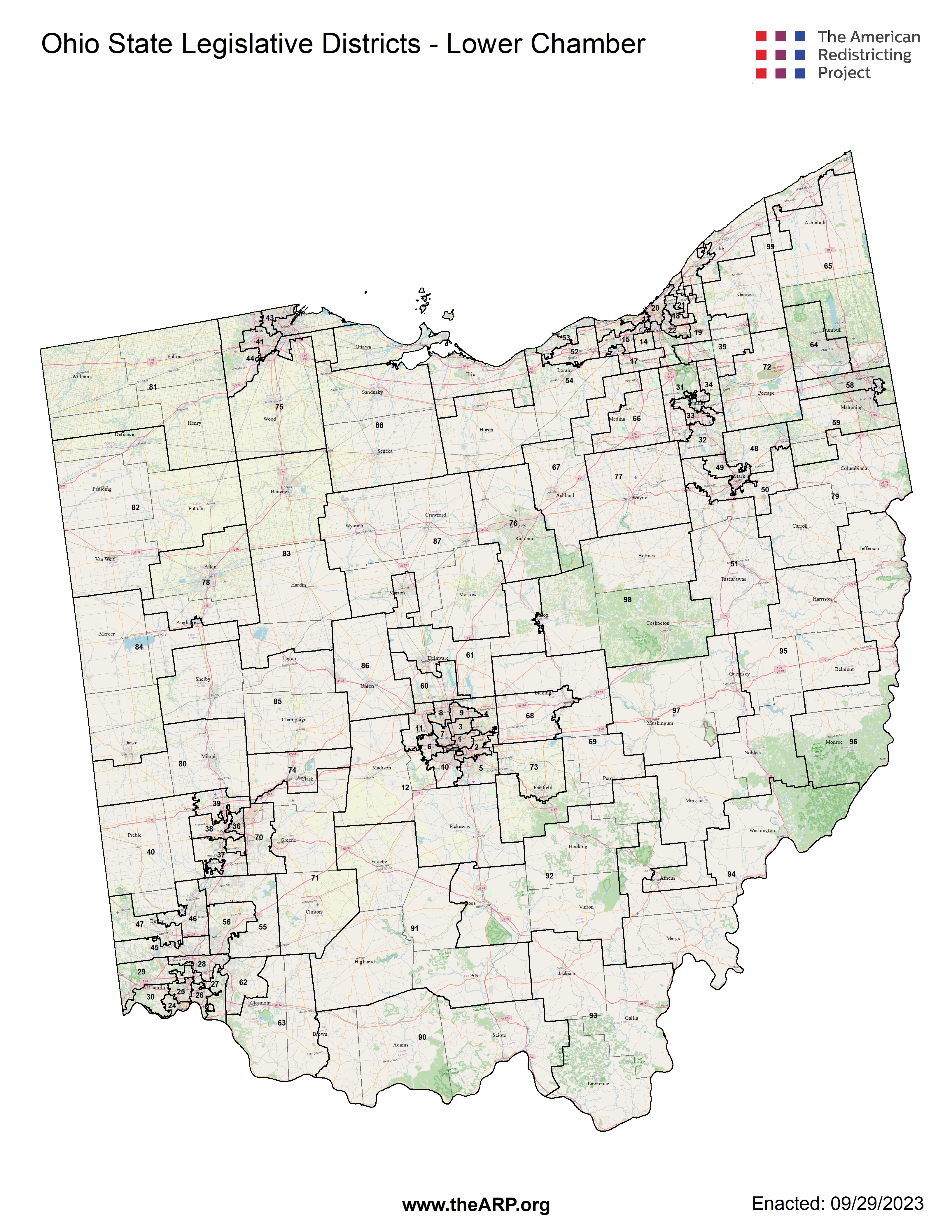
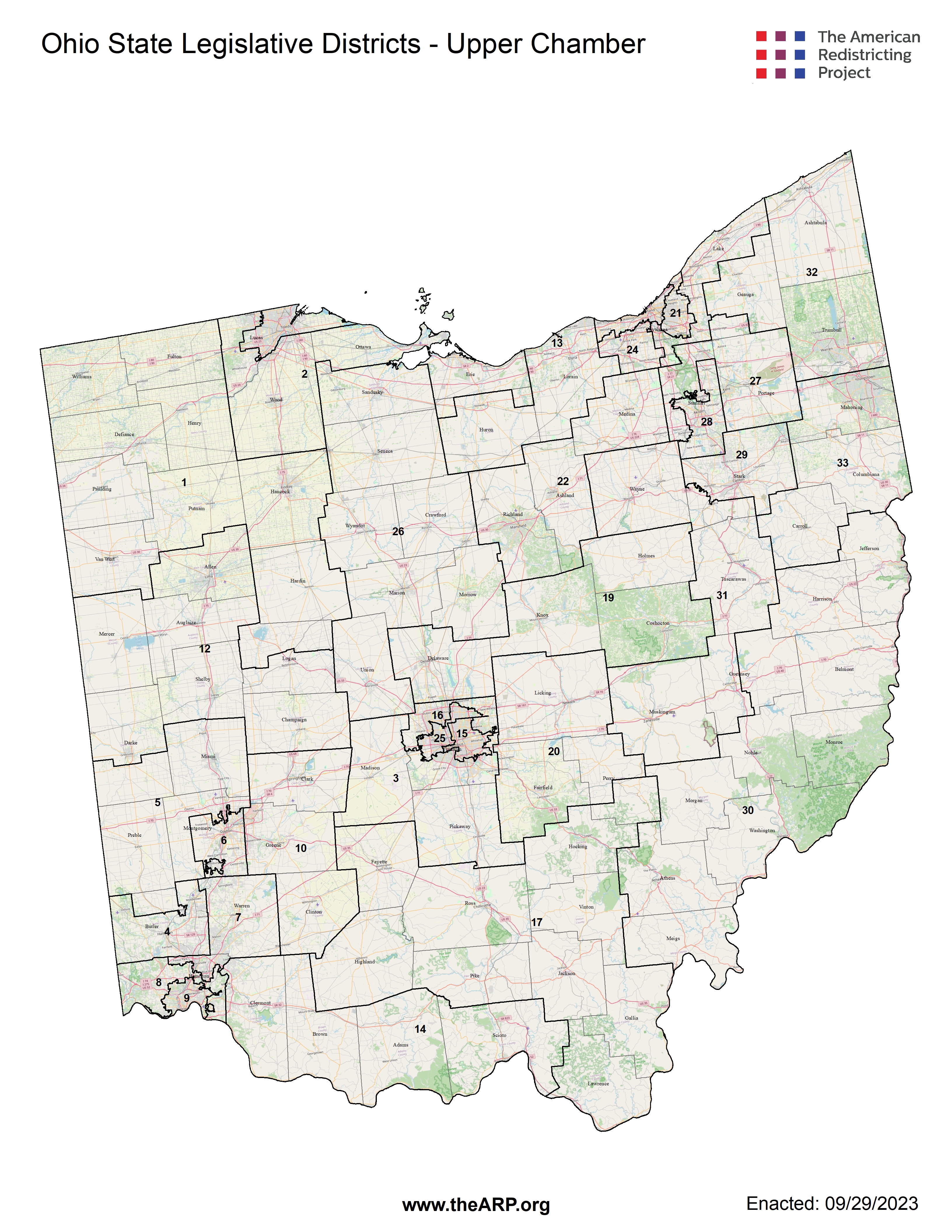
Current districts for Ohio by chamber, shaded by the incumbent’s party.
To view past district shapefiles, see our Map Archive Page.
No active cases on record for Ohio.