Congressional and legislative plans are enacted by the Utah State Legislature, subject to the Governor’s veto. The Legislature is aided by a 7-member advisory body, the Utah Independent Redistricting Commission.
Utah’s congressional delegation remained at 4 seats following the 2020 reapportionment.
Primary Authority: Congressional and legislative plans are enacted by the Utah State Legislature, aided by an advisory commission and subject to the Governor’s veto. The Legislature can override a veto with a 2/3 vote in each chamber. Republicans currently have veto-proof majorities in both chambers.
If a bill is presented to the governor during or after session, the governor has 20 days to sign or veto it; otherwise, it becomes law without signature. Sundays and days of receipt are excluded from these calculations.
Advisory Commission: The Utah Independent Redistricting Commission, a 7-member, politically appointed advisory body, submits 3 proposals for each type of plan to the Legislature which is free to use, amend, or reject them.
Mapping Timeline: The Utah Independent Redistricting Commission must submit its 3 proposals for each type of plan to the Legislature no later than 14 days after the date of the final required public hearing. The Legislature’s redistricting committee must hold a public meeting to consider each of the submitted maps no later than 15 days after they are submitted, and the Legislature cannot enact plans before holding this hearing. The Legislature must enact final congressional and legislative plans by the end of the annual general session next following the receipt of decennial census results. [Utah Const. art. IX, § 1; Utah Code Ann. § 20A-20-303]
Redistricting Criteria: There are no binding congressional or legislative criteria applicable to the Legislature’s plans, but the following criteria apply to the Commission’s plan proposals:
Map Challenges: Not specified.
Types of Measures: Direct and indirect initiatives are permitted to amend statutes but not the state constitution. Referendums are permitted to amend statutes. Legislatively initiated ballot measures can amend both statutes and the state constitution.
Single-Subject Rule: Yes.
Initiative Subject Restrictions: No.
Signature Requirements: 5 preliminary signatures are required from sponsors who are residents of Utah and have voted in a general election in Utah within the last 3 years. “Active voters” as used below refers to the number as of January 1 immediately following the last general election.
Indirect initiative petitions require signatures equal to 4% of active voters in the state and 4% of active voters in each of at least 26 state Senate districts. If the Legislature does not enact an indirect initiative petition, proponents must gather additional signatures equal to 4% of active voters in the state. Direct initiative petitions require 8% of active voters in the state and 8% of active voters in each of at least 26 state Senate districts. Referendums require signatures equal to 8% of the active voters in the state and 8% of the active voters in each of at least 15 counties. Utah's Lieutenant Governor has not yet released the number of active voters as of January 1, 2023, which determines the number of signatures required for measures to be placed on the 2024 ballot, but when it does, that information can be found here.
Submission Deadlines: Initiative petitions must be submitted no later than the earlier of: 30 days after the day on which the 1st individual signed the initiative packet; 316 days after the day on which the initiative petition application is filed; or the February 15 immediately prior to the next regular election after the application is filed. Referendums must be submitted no later than the earlier of: 14 days after the day on which the 1st individual signs the referendum packet or 40 days after the end of the legislative session in which the law was passed.
Circulation Period: There is no specified circulation period for initiative petitions. However, if the proponents fail to secure the required number of signatures within the specified time period, they must submit a new application, obtain new signature sheets, and collect signatures again.
Ballot Title and Summary: A title for the proposed law is written by the proponents and the ballot title is written by the Office of Legislative Research and General Counsel. Expedited reviews for titles and summaries are permitted.
Other Requirements: A fiscal impact statement is required. Circulators must be at least 18 years old and a resident of the state. Measures that make changes to laws regarding the taking of wildlife or the season for, or method of, taking wildlife require 2/3 supermajorities to pass. The Legislature can amend a statutory initiative by majority vote. The Legislature can make technical corrections to an indirect statutory initiative. Laws passed by a 2/3 majority in both legislative chambers cannot be subject to a referendum. Initiatives are permitted on general election ballots but not on primary, special, or odd-year election ballots.
[Utah Const. art. VI, §§ 1, 22; Utah Code Ann. §§ 20A-7-101 – 20-A-801; Utah Lt. Governor Elections Website]
2020
2010
2000
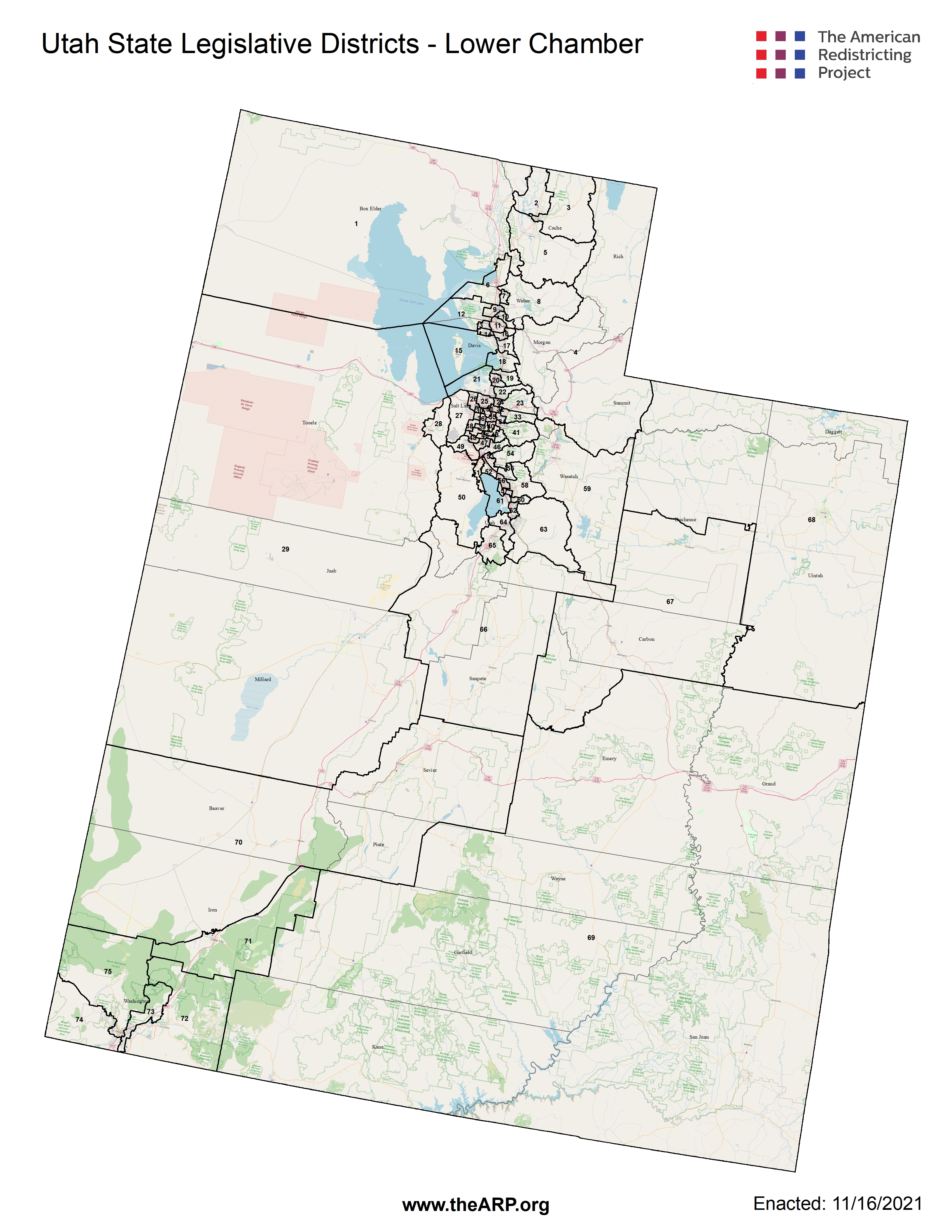
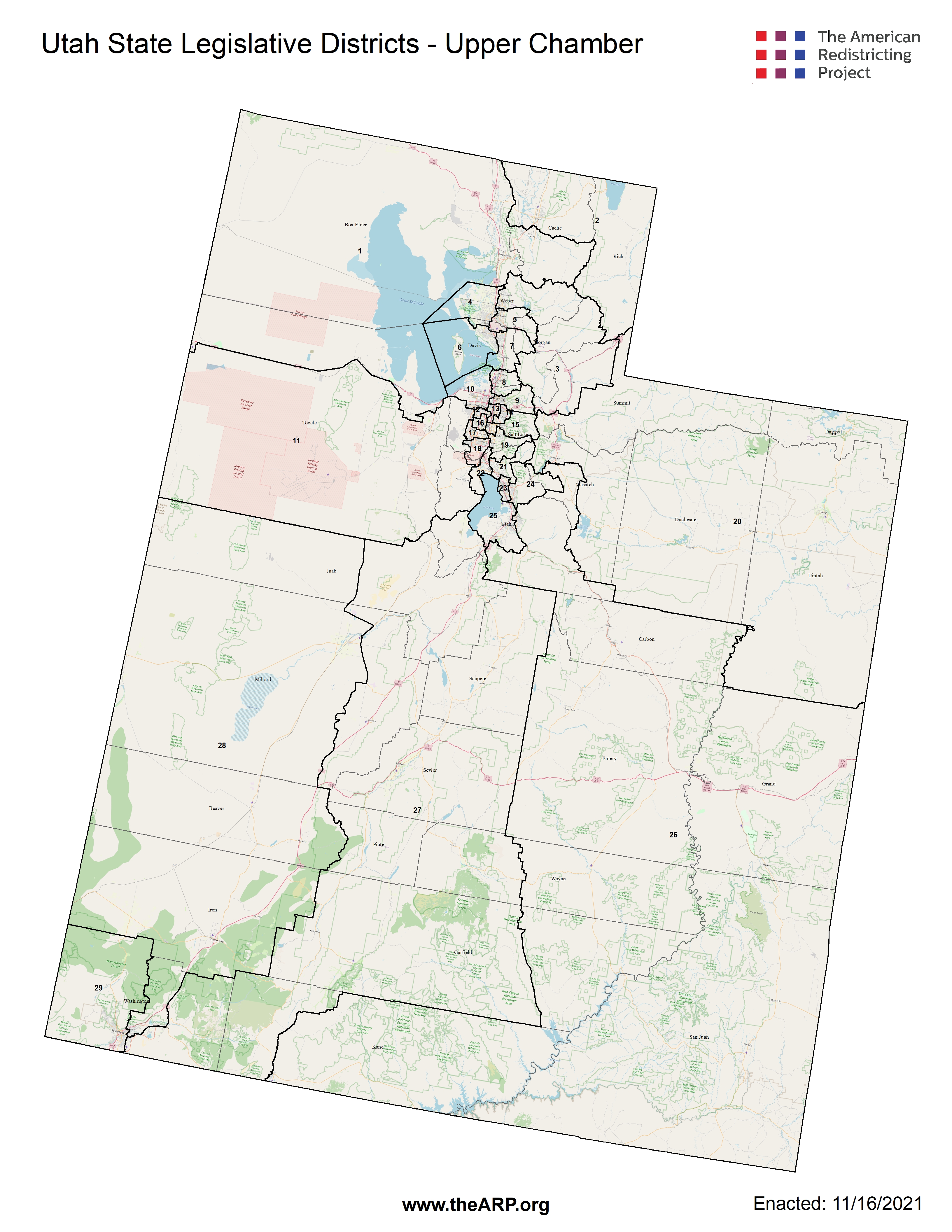
Current districts for Utah by chamber, shaded by the incumbent’s party.
To view past district shapefiles, see our Map Archive Page.