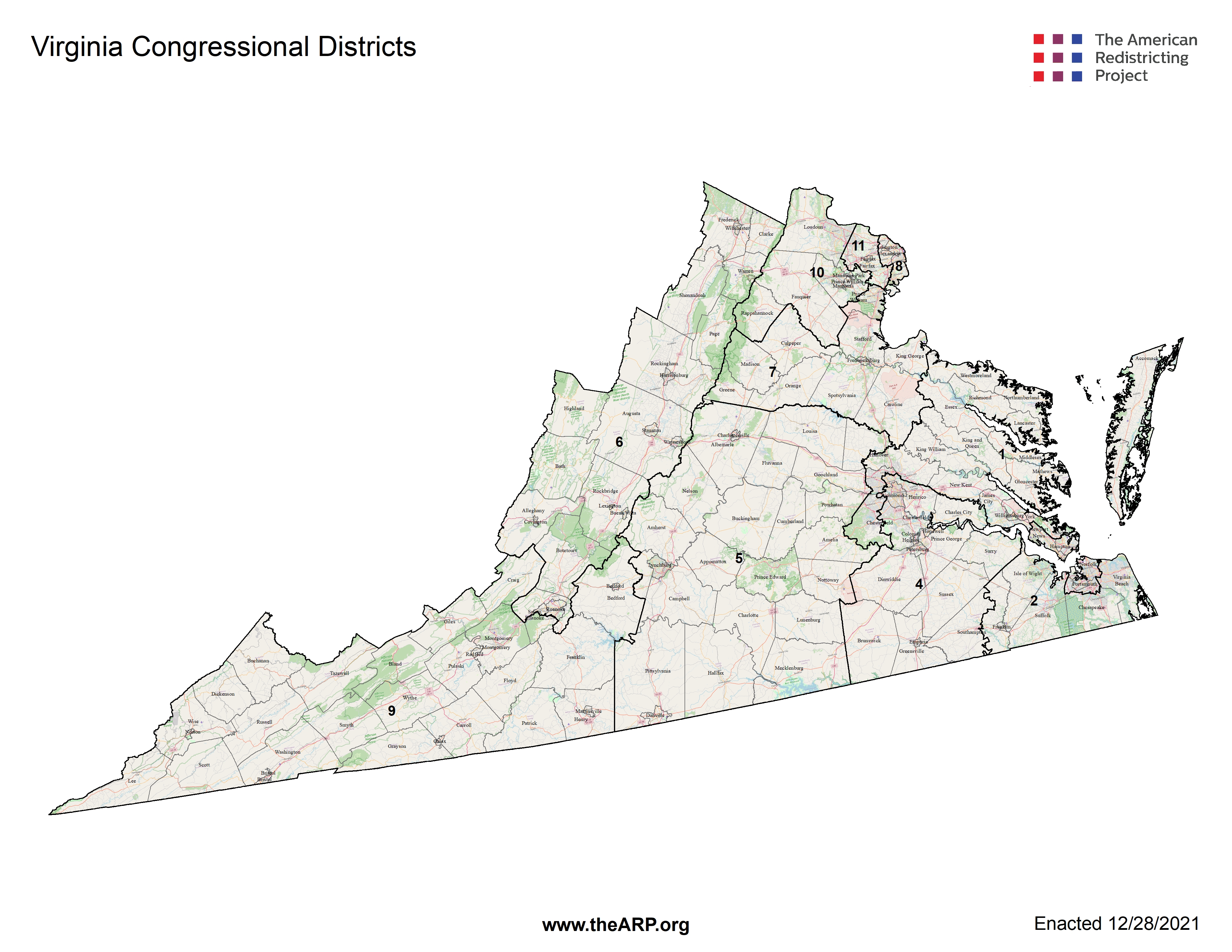
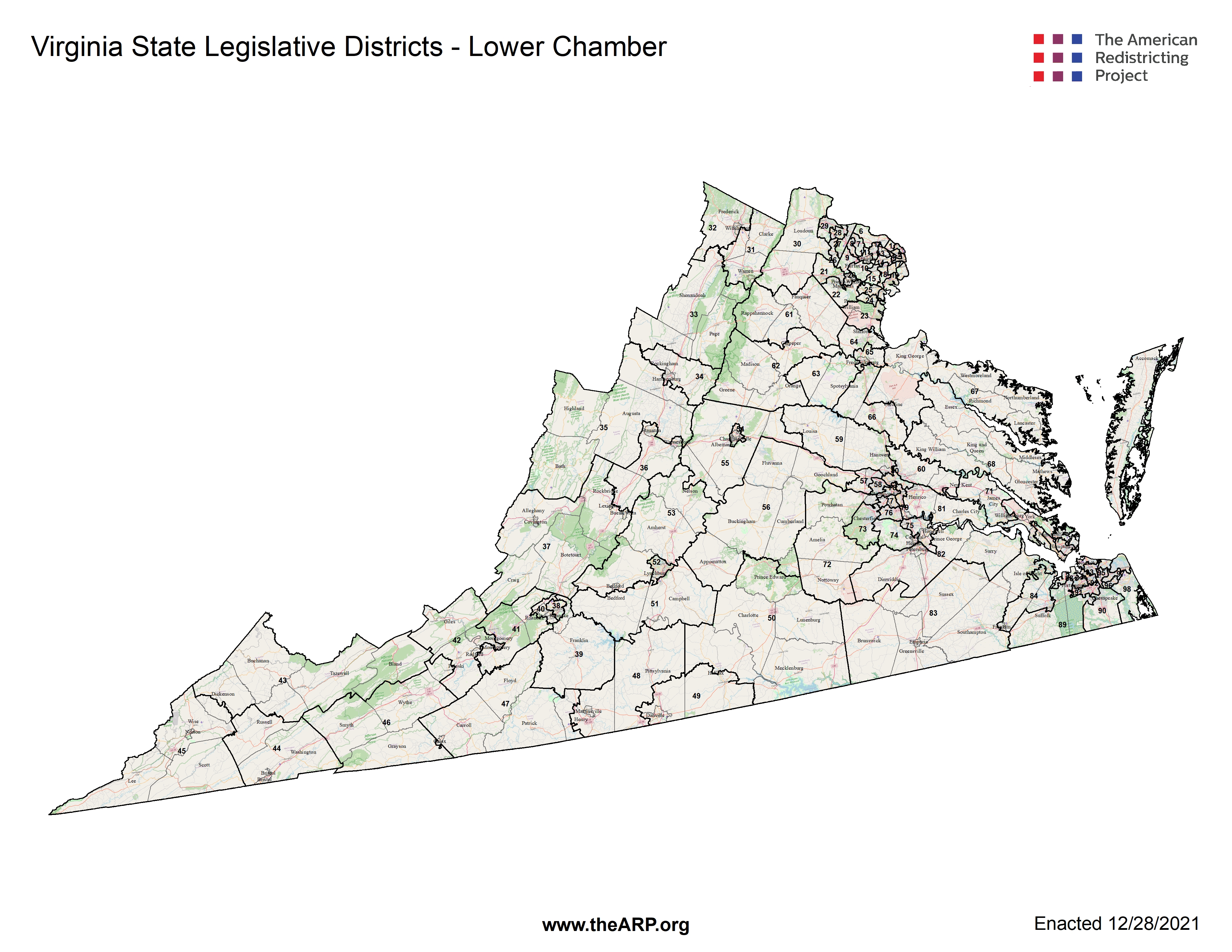
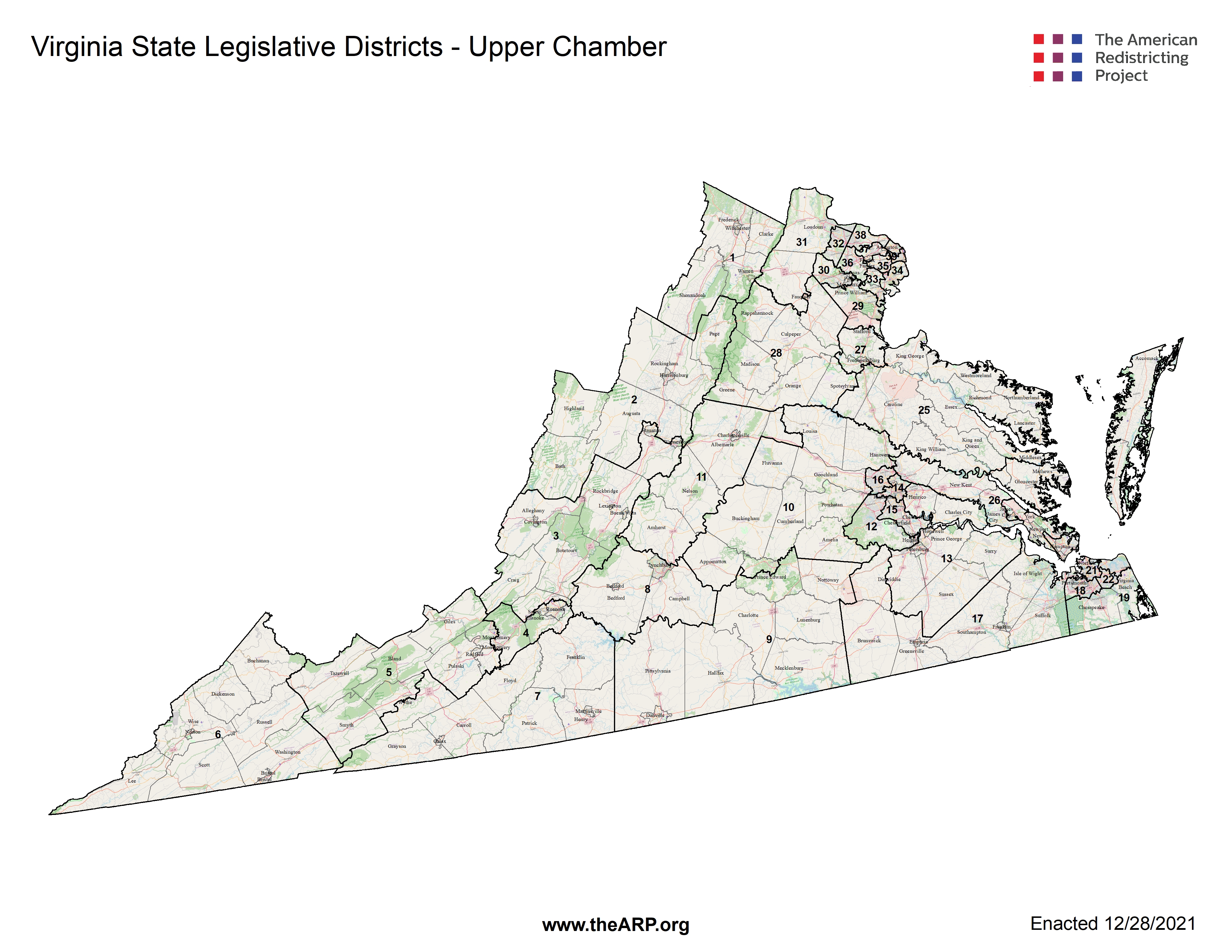
Primary Authority: The Virginia Redistricting Commission, a 16-member body comprised of political appointees and citizen-applicants, draws congressional and legislative plan proposals and submits them to the Virginia General Assembly for approval, without amendment. Once passed by both chambers, plans become law without the Governor’s signature.
- Members: 8 Commissioners are selected from the Virginia General Assembly; 4 from the Senate and 4 from the House. The President of the Virginia Senate, the Speaker of the Virginia House, and the minority leaders from both chambers each appoint two members. The remaining 8 Commissioners are selected from a pool of citizen-applicants by the Redistricting Commission Selection Committee, a panel of 5 retired Virginia circuit court judges. The Chief Justice of the Supreme Court of Virginia submits the names of at least 10 retired judges to the majority and minority leaders of the Virginia General Assembly. Each leader selects one judge to serve and then those four judges select the fifth judge who serves as chair of the Selection Committee. The Selection Committee administers an application for process for interested citizens and a list of eligible applicants is forwarded to the legislative leaders. The legislative leaders each submit a list of at least 16 candidates to the Selection Committee and the Committee selects two persons from each list to be the final 8 Commissioners. [Va. Const. art. II, § 6-A(b); Va. Code Ann. §§ 30-392(A), (C), (E); 30-393(A), (B); 30-394(A)–(F)]
- Timing: The initial 8 legislator Commissioners must be appointed no later than December 1 of years ending in 0. The Chief Justice of the Supreme Court of Virginia must submit their list of retired judges to the legislative leaders by November 15 of years ending in 0. The leaders must select the initial 4 Committee members by November 20 and those 4 must select the 5th member-judge within three days of being notified of their selection. Within 3 days of the appointment of the 5th judge to the Selection Committee, the Committee must adopt an application process for citizen-commissioners which must begin no later than December 1 of years ending in 0 and end after 4 weeks. The list of eligible applicants must be delivered to legislative leaders within 2 days of the end of the application period. The legislative leaders must send their list of 16 citizen-candidates to the Selection Committee by January 1 of years ending in 1 and the Committee must appoint the citizen-commissioners within two weeks of receipt and no later than January 15 of years ending in 1. The full Commission must hold a public meeting and select its chairman by February 1 of years ending in 1. If a given deadline falls on a Saturday, Sunday, holiday, or day on which the relevant government office is closed, it is pushed to the next available business day. [Va. Const. art. II, §§ 6-A(b), (c); Va. Code Ann. §§ 30-392(B), (C), (E); 30-393(B); 30-394]
- Eligibility: For the Selection Committee, retired judges who are related to or sharing a household with a member of the U.S. Congress or Virginia General Assembly are prohibited from serving. No appointing authority can appoint themselves to serve on the Redistricting Commission and appointments to both the Selection Committee and Redistricting Commission should reflect the state’s racial, ethnic, geographic, and gender diversity. Citizen-Commissioners must have been a Virginia resident and registered voter for 3 years immediately preceding the application period, shall have voted in at least 2 of the 3 previous general elections, and must disclose certain specified information in their application to serve. To be eligible to serve, Citizen-Commissioners must not: hold, have held, or have sought partisan public office or political party office; be employed or have been employed by a member of Congress, member of the Virginia General Assembly, or those institutions directly; be employed or have been employed by any federal, state, or local campaign; be employed or have been employed by any political party or be a member of a political party central committee; be or have been a registered lobbyist or a lobbyist’s principal in the previous 5 years; be related to or sharing a household with any individual that falls into any of these categories. The Chairman of the Redistricting Commission must be a citizen-commissioner. [Va. Const. art. II, § 6-A(b); Va. Code Ann. §§ 30-392(A), (B), (C), (E); 30-393(B); 30-394]
- Voting: The Selection Committee appoints its 5th member and citizen-commissioners by majority vote and a majority including the chairman is required for quorum. For the Redistricting Commission, quorum requires a majority of members, including a majority of the legislative commissioners and a majority of the citizen commissioners. In order to adopt and submit proposed redistricting plans to the General Assembly, plans must receive affirmative votes from at least 6 of the 8 legislative commissioners and at least 6 of the 8 citizen commissioners. For state Senate proposals, at least 3 of the 4 Senate commissioners must vote in favor of it and for state House proposals, at least 3 of the 4 House commissioners must vote in favor of it. [Va. Code Ann. §§ 30-392(E); 30-393(B); 30-394(F); 30-397(A), (B)]
- Public Input & Transparency: The Redistricting Commission must give adequate notice of all meetings and hearings and must maintain a website allowing the public to access information about their activities and submit comments and proposals. All proposals and data used by the Commission must be posted to the website within 3 days of receipt by the Commission. Prior to submitting plan proposals to the General Assembly, the Commission must hold at least 3 public hearings in different parts of the state to collect public input. Selection Committee meetings and records are subject to the Virginia Freedom of Information Act and Committee members are prohibited from communicating with members of the Virginia General Assembly or U.S. Congress, or any persons acting on their behalf, regarding the selection of citizen commissioners after the lists of 16 candidates are received. Redistricting Commission meetings and records are subject to the Virginia Freedom of Information Act and all underlying records and documents pertaining to their work, including internal and external communications, are considered public information. Commissioners, Commission staff, and any advisors or consultants are prohibited from communicating with any person outside the Commission on redistricting related matters outside of a public meeting or hearing. [Va. Const. art. II, §§ 6-A(c), (h), (i); Va. Code Ann. §§ 30-392(E)–(G); 30-396]
Backup Authority: If the Redistricting Commission fails to submit, or the General Assembly fails to enact, a redistricting plan by its relevant deadline, the Supreme Court of Virginia establishes the necessary plan(s). The Court must adopt rules and procedures for this backup redistricting process by March 1 of years ending in 1. Public participation is required for the Court’s redistricting deliberations. Two special masters are appointed to aid the Court. Within 7 days of the Commission’s or General Assembly’s missed deadline, the majority and minority leaders of the Virginia Senate and Virginia House submits a list of three or more nominees to the Court. The Court selects, by majority vote, one special master from the majority leaders’ lists and one from the minority leaders’ lists, both of whom must be qualified, experienced, and possess no conflicts of interest. Justices who are related to or sharing a household with a member of the Virginia General Assembly or U.S. Congress must recuse themselves from these proceedings. [Va. Const. art. II, § 6-A(f), (g); Va. Code Ann. §§ 30-397(C); 30-398(C), (D); 30-399]
Mapping Timeline: After holding the required public hearings, the Redistricting Commission must adopt and submit proposed legislative plans to the General Assembly no later than 45 days following the receipt of census data. It must adopt and submit a proposed congressional plan no later than 60 days following the receipt of census data or by July 1 of that year, whichever occurs later. The General Assembly must vote on plans within 15 days of receipt. If a plan is rejected, the Commission must submit a new plan to the General Assembly within 14 days of its failure and the General Assembly must vote on it within 7 days of receipt. If the Commission fails to meet either of its initial deadlines, it has an additional 14 days following the missed deadline to submit the relevant plan(s) to the General Assembly. If submitted this way, the General Assembly must vote on the plan within 7 days of receipt. If the Commission fails to submit plans by its second deadline, or the General Assembly fails to enact a plan by its relevant deadlines, the Supreme Court of Virginia establishes the necessary plan(s). [Va. Const. art. II, § 6-A(d)–(g); Va. Code Ann. §§ 30-396(B); 30-397(A)–(C); 30-398; 30-399]
Redistricting Criteria: Contiguous; Compact (measured district-by-district and statewide average); As nearly equal in population as practicable (max 5% deviation for legislative districts); Provide opportunities for racial and ethnic communities to elect candidates of their choice, where practicable; Preserve communities of interest (area with similar social, cultural, and economic interests and not based on political affiliation or relationship with a party, elected official, or candidate); May consider political boundaries.
PROHIBITED: Statewide plan unduly favoring or disfavoring a political party; Diluting or diminishing ability of racial or language minorities to elect candidates of choice alone or in coalition with others; Districts resulting in denial or abridgement of the rights of racial or language minorities to participate in political process and elect candidates of choice (using specifically modified totality of circumstances standard) [Va. Const. art. II, § 6; Va. Code Ann. § 24.2-304.04]
Map Challenges: Venue not specified, but if any plan is invalidated by a court the Commission must reconvene and adopt a remedial plan correcting the deficiencies. [Va. Code Ann. § 30-400]